


Euronav earnings date
Euronav (OCW) Q3 2026 Earnings Report
DE:OCW Q3 2026 EPS Results
- Actual EPS
- EUR 1.18
- Consensus EPS
- EUR 0.68
- Beat/Miss
- Beat by +EUR 0.49
- One Year Ago EPS
- -EUR 0.07
DE:OCW Q3 2026 Revenue Results
- Actual Revenue
- EUR 697.89M
- Expected Revenue
- EUR 517.82M
- Beat/Miss
- Beat by +EUR 180.07M
- YoY Revenue Growth
- +79.54%
Earnings Announcement Details
- Quarter
- Q3 2026
- Date
- 11/24/2026
- Time
- Before Open
- Conference Call
- Tuesday, November 24, 2026
Euronav's next earnings date is estimated for February 25, 2027, based on past reporting schedules.
Q3 2026 Earnings Call Audio
Q3 2026 Earnings Slide Deck
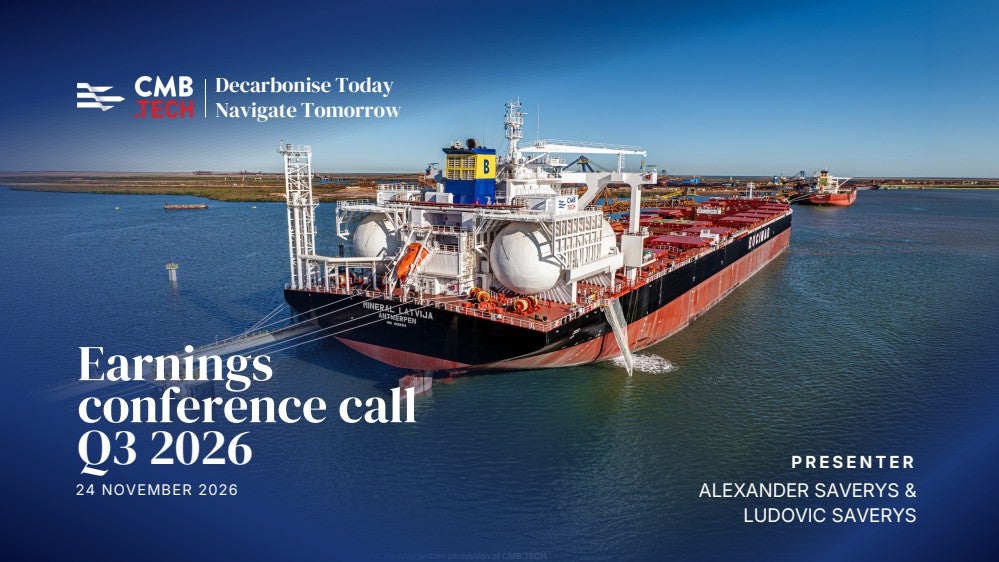
Q3 2026 Earnings Call Summary
The call was strongly positive overall, supported by record-level profitability, recurring EBITDA above $550 million, strong tanker spot rates and asset-sale gains, a strengthened balance sheet, substantial projected free cash flow, and progress in ammonia-powered shipping. Management also highlighted favorable dry bulk fundamentals and continued offshore and alternative-fuel growth. The main concerns were the rapidly expanding tanker, container and chemical tanker order books, softer or muted demand in some markets, higher current ammonia-bunkering costs, positioning-related offshore costs, and uncertainty around international decarbonization regulation.
For 2027, Cmb.Tech shows $722 million of free cash flow after CapEx at the stated spot rates, roughly $900 million in a plus 10% scenario and more than $1 billion if spot rates increase by 20%; CapEx is expected to be roughly $400 million in 2027, including $320 million funded by committed financing and $80 million from operational cash flow or sale of assets. Fleet growth is expected at 5.5% to 6% in Capesizes, 7% for VLCCs, 9% for Suezmaxes, close to 10% for containers, and 8% for chemical tankers, while offshore wind and oil and gas demand are expected to absorb offshore newbuildings. Management believes dry bulk rates will be above historical averages and Panamax rates will be above historical averages at healthy profit-making levels, continues to target a 50% payout for the moment, but said it is too early to say specifically on dividends for Q1, Q2, Q3 in '27; latest by 2030, it is expecting diesel parity on green ammonia.
- Strong Third-Quarter Profit and EBITDACmb.Tech reported a third-quarter profit of $374 million, including an approximately $100 million capital gain from the sale of two vessels. EBITDA exceeded $550 million for the third consecutive quarter.
- Balance Sheet Strengthening and LiquidityLiquidity stood at $561 million, equity increased to 58% of total assets, and management said the company continued to delever its balance sheet while paying dividends.
- Dividend DistributionThe Board proposed a dividend of $0.65, representing roughly 50% of net profits including capital gains. An interim dividend of $0.21 will be subject to withholding tax, while $0.44 will be paid without withholding tax.
- Contract Backlog and Fleet ExpansionThe contract backlog remained at $3.1 billion. The company added a multipurpose offshore support vessel with delivery scheduled for 2029 and took delivery of four newbuildings: one Newcastlemax Mineral Europa, the CSOV Windcat Antwerpen and two CTVs.
- Tanker Asset Sale GainsCmb.Tech sold two Suezmaxes in Q3 for a capital gain of $100 million. It had already locked in approximately $190 million of Q4 capital gains from additional Suezmax sales, and said it had sold nine VLCCs and five Suezmaxes during the year for more than $670 million of combined capital gains.
- Elevated Tanker Asset ValuesManagement said a 15-year-old VLCC averaged $46 million in value over the last 10 years versus approximately $165 million today, representing an increase of more than 250% over the 10-year average.
- Strong Projected Operational Free Cash FlowBased on the stated 2027 spot-rate assumptions, including $122,000 for VLCCs and $77,000 for Suezmaxes, the company projected $722 million of free cash flow after capital expenditures. The projection increased to roughly $900 million with spot rates 10% higher and more than $1 billion with spot rates 20% higher.
- CapEx Program Nearing CompletionThe company’s CapEx program had declined from more than $3 billion two years ago to $840 million in October and was expected to reduce to approximately $660 million by year-end. The remaining heavy CapEx year is 2027, with roughly $400 million of payments, including $320 million funded through committed financing and $80 million expected from operational cash flow or asset sales.
- Positive Dry Bulk Supply-Demand BalanceManagement described dry bulk demand as supportive across iron ore, bauxite, grains and coal, particularly on a tonne-mile basis. The order book-to-fleet ratio was 19% for Capes and 14% for Panamaxes, and management said the overall dry bulk balance was positive.
- Healthy Dry Bulk RatesIn Q3, the fleet achieved rates of $43,000 for Newcastlemaxes, $35,000 for Capes and $20,000 for Panamaxes, which management described as good profit-making rates.
- Bauxite and New-Energy Vehicle Demand OpportunityManagement said aluminum intensity in new-energy vehicles is increasing and that new-energy vehicles could represent 70% of passenger cars and 40% of commercial vehicles by 2030. This could add 8 million tonnes of aluminum demand and more than 20 million tonnes of bauxite demand, equivalent to close to 100 Newcastlemax loadings per year, with most of the additional bauxite demand expected to be imported to China.
- Simandou Iron Ore GrowthIron ore loadings from Morebaya increased from 100,000 tonnes in November 2025 to 5 million tonnes in October 2026. Management said the trade was at an annualized 60 million tonnes of exports, with the theoretical 120 million-tonne target within reach by the end of next year.
- Successful Ammonia-Powered Mineral Europa OperationMineral Europa, the company’s first ammonia-powered dry bulk vessel, entered service, completed ammonia bunkering in Zhoushan and Port Hedland, and completed the first iron ore shipment in the world with a ship fully powered by ammonia. The company said another 20 ships are coming in the following months and years.
- Exceptional VLCC and Suezmax Spot RatesVLCC spot rates were close to $150,000 per day in Q3, while the Q4 rate fixed so far was stated as $635,000. Suezmax spot rates were also close to VLCC levels in Q3, and Q4 rates achieved so far were $377,000 per day.
- Container Fleet Supported by Long-Term ContractsThe company has four container vessels on the water, all on long-term time charters, and expects delivery of its first ammonia-powered containership in January under a 15-year contract.
- Chemical Tanker Fleet Remaining ProfitableAlthough the chemical tanker market was described as softer, the one-year time-charter assessment remained at $18,000 per day. Management said the market remained in profitable territory, partly because chemical tankers had been taking product cargoes.
- Offshore Energy Fleet Growth and DemandThe company took delivery of the Windcat Antwerpen, its fourth CSOV, with two additional CSOVs scheduled for delivery next year and two larger CSOVs in 2028 and 2029. Offshore wind capacity by 2035 is expected to triple, and management said oil and gas and offshore wind demand should absorb next year’s newbuild deliveries.
- Ammonia Propulsion Program and Infrastructure DevelopmentThe ammonia propulsion program comprises 10 ships delivered with ammonia engines, eight ships to be retrofitted, one containership and two chemical tankers. Cmb.Tech also owns 25% of Chinese ammonia logistics company Andefu and plans to support development of pipelines, storage terminals and additional bunker barges.
- Progress Toward Green-Ammonia Cost CompetitivenessManagement said it expects the cost of green ammonia and its logistics to decline and stated that it expects green ammonia to reach diesel parity by 2030 at the latest.
- Emission and Fuel Verification ProgramThe company said emissions on board Mineral Europa and the carbon content of the fuel, including well-to-wake emissions, are being independently verified by organizations including BV, DNV and Lloyd’s Register.
- Capital Allocation FlexibilityManagement said it intends to continue dividends, deleveraging and remaining CapEx for now. It stated that there is no concrete M&A transaction currently under review, no current LNG transaction or appetite, and no massive newbuild program planned at present.
DE:OCW Earnings History
| Report Date | Fiscal Quarter | Forecast / EPS | Last Year's EPS | EPS YoY Change | Press Release |
|---|---|---|---|---|---|
| Feb 25, 2027 | 2026 (Q4) | 1.04- | 0.26 | ― | ― |
| Nov 24, 2026 | 2026 (Q3) | 0.681.18 | -0.07 | 1780.00% (+1.25) | |
| Aug 27, 2026 | 2026 (Q2) | 0.771.08 | -0.29 | 478.32% (+1.37) | |
| May 19, 2026 | 2026 (Q1) | 0.230.30 | 0.18 | 63.24% (+0.12) | |
| Feb 26, 2026 | 2025 (Q4) | 0.320.26 | 0.46 | -42.95% (-0.20) | |
| Nov 26, 2025 | 2025 (Q3) | 0.04-0.07 | 0.18 | -138.67% (-0.25) | |
| Aug 28, 2025 | 2025 (Q2) | 0.02-0.29 | 0.87 | -132.84% (-1.16) | |
| May 21, 2025 | 2025 (Q1) | -0.050.18 | 2.29 | -91.91% (-2.10) | |
| Feb 27, 2025 | 2024 (Q4) | 0.180.46 | 1.88 | -75.41% (-1.41) | |
| Nov 07, 2024 | 2024 (Q3) | 0.140.18 | 0.54 | -66.29% (-0.36) |
The table shows recent earnings report dates and whether the forecast was beat or missed. See the change in forecast and EPS from the previous year.
