


Navios Maritime Partners earnings date
Navios Maritime Partners (3PXA) Q3 2026 Earnings Report
DE:3PXA Q3 2026 EPS Results
- Actual EPS
- EUR 5.07
- Consensus EPS
- EUR 4.08
- Beat/Miss
- Beat by +EUR 0.98
- One Year Ago EPS
- EUR 2.53
DE:3PXA Q3 2026 Revenue Results
- Actual Revenue
- EUR 386.76M
- Expected Revenue
- EUR 338.95M
- Beat/Miss
- Beat by +EUR 47.81M
- YoY Revenue Growth
- +24.51%
Earnings Announcement Details
- Quarter
- Q3 2026
- Date
- 11/04/2026
- Time
- Before Open
- Conference Call
- Wednesday, November 4, 2026
Navios Maritime Partners's next earnings date is estimated for February 18, 2027, based on past reporting schedules.
Q3 2026 Earnings Call Audio
Q3 2026 Earnings Slide Deck
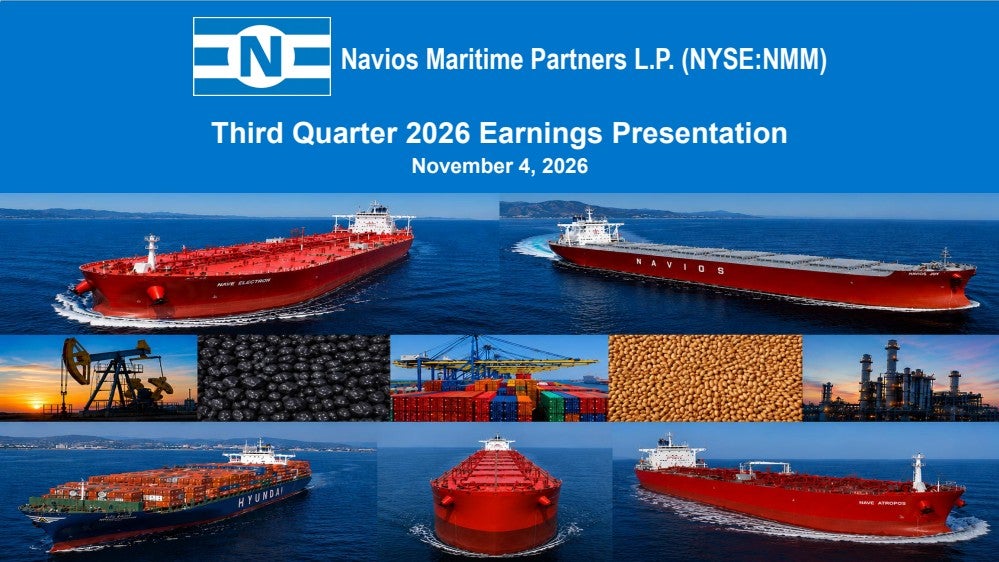
Q3 2026 Earnings Call Summary
The call was strongly positive overall. Navios reported substantial revenue, EBITDA and earnings growth, record contracted revenue, improved leverage, strong liquidity, fleet expansion and favorable tanker and dry bulk market conditions. The main negatives were higher operating and corporate expenses, a slight decline in available days and container TCE, increased borrowings following newbuilding deliveries, and explicit geopolitical and recessionary risks affecting shipping markets.
For Q4 of 2026, Navios has fixed 80% of available days at a net average rate of $31,837 per day, with contracted revenue exceeding estimated total cash operating costs by $133.6 million and 2,713 remaining open or index-linked days; for 2027, contracted revenue exceeds estimated total cash operating costs by $4 million, 56% of available days are fixed at a net rate of $29,605 per day, and 25,220 days remain open or index-linked, with every $1,000 per day creating over $25 million of additional free cash. The company expects 34 newbuilding vessels to deliver through 2029, representing $3.1 billion of investment and about $2.3 billion in contracted revenue over a 5-year average charter duration; 2027 exposure is 98% fixed for containerships, 72% fixed for tankers and 87% of dry bulk days open or indexed, while tanker rates are expected to remain elevated over the longer term, vessel utilization will continue to run at high levels supporting elevated rates for the near term, and the dry bulk and tanker markets look positive over the medium term.
- Strong Third-Quarter and Nine-Month EarningsThird-quarter net income was $185.7 million, with earnings per common unit of $6.42. For the first nine months, net income was $460 million and earnings per common unit were $15.83. The company also announced a quarterly cash distribution of $0.06 per unit.
- Revenue and TCE GrowthThird-quarter revenue increased 25% to $432 million from $347 million in Q3 2025, due to a higher combined time charter equivalent rate. Combined Q3 TCE increased 26% to $30,371 per day. First-nine-month revenue increased 23% to $1.2 billion from $979 million, while combined TCE increased 24% to $28,209 per day.
- Improved Adjusted Earnings and EBITDAAdjusted EBITDA increased by $78 million to $272 million in Q3 2026, and adjusted income almost doubled to $164 million from $84 million. For the first nine months, adjusted EBITDA increased by $198 million to $718 million, while adjusted net income doubled to $396 million from $196 million.
- Higher Sector TCE RatesIn Q3, dry bulk TCE increased 43% to $25,708 per day and tanker TCE increased 38% to $36,183 per day. For the first nine months, dry bulk TCE increased 45% to $22,332 per day, tanker TCE increased 29% to $33,897 per day, and container TCE increased 1% to $31,504 per day.
- Fleet Expansion Through NewbuildingsNavios committed approximately $703 million during Q3 and Q4 to acquire seven newbuilding vessels: four 10,100 TEU containerships, one VLCC and two MR2 product tankers. The company also took delivery of two newbuildings: an MR2 chartered for about five years at a net daily rate of $23,400 and a 7,900 TEU containership chartered for about four years at a net daily rate of $42,463.
- Modern and Diversified FleetNavios operates 182 vessels across three segments and 15 asset classes. The fleet has an average age of 8.5 years versus an industry average of 13.8 years, while the tanker fleet has an average age of 4.9 years versus an industry tanker average of 14.2 years. The in-the-water fleet is split into approximately thirds by value among tankers, dry bulk and containerships.
- Large Fleet Value and Contracted Revenue BacklogThe fleet is valued at approximately $8.7 billion, with $6.2 billion in vessel net equity value. The fully delivered fleet has an estimated charter-free value of approximately $12.4 billion. Contracted revenue reached a record $5 billion, including $2.1 billion from tankers, $2.6 billion from containerships and $0.3 billion from dry bulk, with charters extending through 2037.
- Strong Forward Cash Flow CoverageFor Q4 2026, Navios fixed 80% of available days at a net average rate of $31,837 per day, and contracted revenue exceeded estimated total cash operating costs by $133.6 million. For 2027, contracted revenue already exceeded estimated total cash operating costs by $4 million; 56% of available days were fixed at a net rate of $29,605 per day, with 25,220 days open or index-linked. Every $1,000 per day on those days creates over $25 million of additional free cash.
- Growth in Contracted RevenueSince the start of Q3, Navios added approximately $735 million of contracted revenue: $537 million from eight containerships, $145 million from four tankers and $53 million of minimum revenue from two dry bulk vessels.
- Long-Term Newbuilding Commitments with Charter CoverageNavios has 34 newbuilding vessels delivering through 2029, representing $3.1 billion of investment. Long-term creditworthy charters are expected to generate about $2.3 billion in contracted revenue over a five-year average charter duration, mitigating residual value risk for the newbuilding program.
- Balanced Chartering StrategyFor 2027, 98% of containership days are fixed, 72% of tanker days are fixed and 87% of dry bulk days are open or indexed. The company stated that it fixes long term when the market pays and remains shorter when it does not, including a five-year Capesize newbuilding charter with a floor of $26,000 per day plus profit sharing.
- Improved Leverage and LiquidityNet loan-to-value was 23.1%, and net debt to book capitalization improved to 29%. Navios had $657 million of available liquidity, including $508 million of cash and cash equivalents and approximately $150 million available under two revolving facilities. The company also had 62 debt-free vessels worth around $2.4 billion.
- Debt Repayment and Flexible Financing StructureNavios accelerated repayment of $90 million of debt maturing from 2028 through 2030 and voluntarily repaid approximately $170 million of debt during the first nine months. Approximately 44% of debt was fixed-rate and 52% had no loan-to-value covenant. The company maintained more than 15 active banking relationships, leasing structures in Japan and China, and a $330 million senior unsecured bond.
- Unit Repurchases and Return of CapitalNavios authorized an additional $200 million common unit repurchase program in 2026. Since the program began in Q2 2024, the company repurchased approximately 2 million common units for $104.4 million, reducing outstanding units by 6.7% from approximately 30.2 million to 28.2 million. Management estimated approximately $202 million of net asset value accretion, equivalent to $6.90 per unit, and stated that approximately $48 million had been returned to unitholders over the last 12 months through repurchases and cash distributions.
- Five-Year Platform GrowthOver the past five years, contracted revenue grew about 50% to a record $5 billion, EBITDA run rate exceeded $1 billion, and fleet value including the newbuilding program expanded to around $12.4 billion. Management also stated that NAV had more than doubled and the share price had increased by over 300% over the same period.
- Favorable Tanker Market ConditionsThe Strait of Hormuz disruption tightened tanker availability and drove freight rates higher. VLCC rates reached $1.4 million per day, while the Baltic Clean Tanker Index reached an all-time high of 3,015 points, 264% above its long-term average of 826. Management stated that tanker rates remain supported by elevated ton miles, restocking needs and a constrained fleet.
- Positive Dry Bulk Supply and Demand OutlookDry bulk demand has grown at about 4% compound annual ton-mile growth over the last 25 years. The order book was approximately 15% of the fleet, while 39% of vessels were 15 years old. New iron ore projects are expected to add 180 million tonnes of long-haul trade, creating demand for an additional 249 Capes compared with 228 Capes on order through 2028.
- Positioning in the Container MarketNavios stated that smaller containership segments are positioned to benefit from shifting trade patterns. By 2029, more than 50% of the 2,000-to-9,000 TEU fleet will be 20 years or older, while non-mainlane trades are generally growing faster than traditional mainlane trades. The company said its fleet is well positioned and benefits from long-term employment with high-quality charterers.
DE:3PXA Earnings History
| Report Date | Fiscal Quarter | Forecast / EPS | Last Year's EPS | EPS YoY Change | Press Release |
|---|---|---|---|---|---|
| Feb 18, 2027 | 2026 (Q4) | 6.48- | 3.04 | ― | ― |
| Nov 04, 2026 | 2026 (Q3) | 4.085.07 | 2.53 | 100.00% (+2.53) | |
| Aug 20, 2026 | 2026 (Q2) | 3.894.16 | 1.93 | 116.28% (+2.24) | |
| May 21, 2026 | 2026 (Q1) | 2.483.00 | 1.41 | 112.03% (+1.58) | |
| Feb 19, 2026 | 2025 (Q4) | 2.143.04 | 2.34 | 30.27% (+0.71) | |
| Nov 18, 2025 | 2025 (Q3) | 2.272.53 | 2.82 | -10.16% (-0.29) | |
| Aug 21, 2025 | 2025 (Q2) | 1.581.93 | 2.74 | -29.74% (-0.81) | |
| May 07, 2025 | 2025 (Q1) | 1.271.41 | 2.08 | -31.90% (-0.66) | |
| Feb 13, 2025 | 2024 (Q4) | 2.422.34 | 3.87 | -39.58% (-1.53) | |
| Nov 05, 2024 | 2024 (Q3) | 2.992.82 | 2.4 | 17.54% (+0.42) |
The table shows recent earnings report dates and whether the forecast was beat or missed. See the change in forecast and EPS from the previous year.
