

Want to see CCEC full AI Analyst Report?
Capital Clean Energy Carriers (CCEC) Q3 2026 Earnings Report
CCEC Q3 2026 EPS Results
- Actual EPS
- $0.57
- Consensus EPS
- $0.51
- Beat/Miss
- Beat by +$0.06
- One Year Ago EPS
- $0.39
CCEC Q3 2026 Revenue Results
- Actual Revenue
- $138.14M
- Expected Revenue
- $126.52M
- Beat/Miss
- Beat by +$11.61M
- YoY Revenue Growth
- +38.82%
Earnings Announcement Details
- Quarter
- Q3 2026
- Date
- 10/30/2026
- Time
- Before Open
- Conference Call
- Friday, October 30, 2026
Capital Clean Energy Carriers's next earnings date is estimated for January 29, 2027, based on past reporting schedules.
Q3 2026 Earnings Call Audio
Q3 2026 Earnings Slide Deck
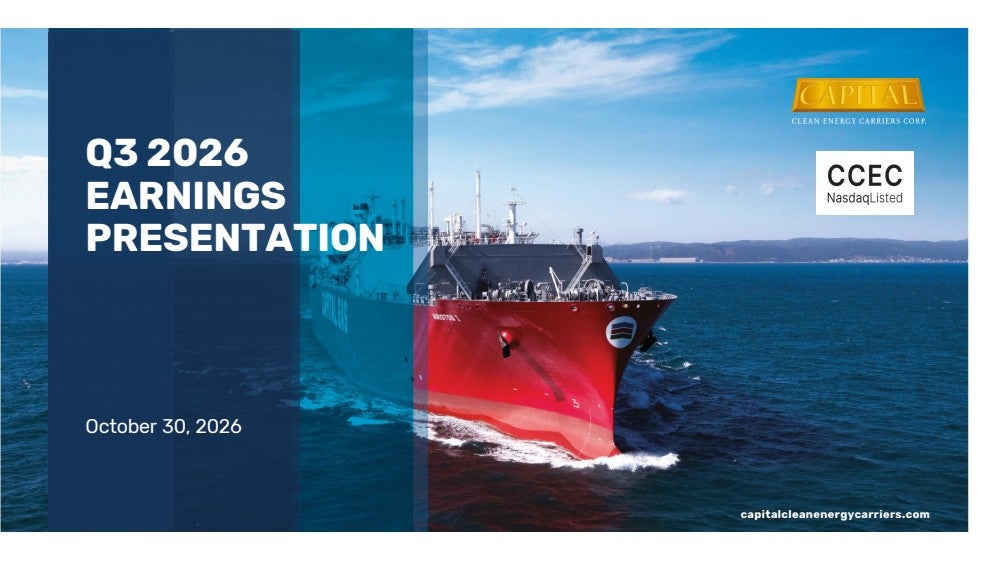
Q3 2026 Earnings Call Summary
The call was predominantly positive. Management reported strong revenue and net income growth, continued dividend payments, substantial contracted backlog, solid liquidity, progress on the newbuilding program and favorable long-term LNG and gas carrier demand fundamentals. These positives outweighed higher financing and fleet-related costs, softer and volatile third-quarter LNG spot rates, low European inventories and near-term vessel oversupply.
Management expects to fully fund the remaining CapEx while also releasing significant liquidity to the company, assuming 70% debt financing for the vessels that do not yet have facilities in place and excluding future operating cash flows and net proceeds from the sale of Amore Mio to the previously announced LNG joint venture; management expects the Middle East situation to continue for at least the first half of 2027, views the supply and demand inflection point as happening in 2028, and expects older steam and early dual-fuel tonnage to leave the fleet at a faster pace as rates normalize. Europe is expected to enter November only 75% to 78% full, around 10 points below the 5-year average, while a cold winter could take stocks down to 10% to 15% by the end of the season, supporting LNG demand into 2027; management expects volatility in both directions, and said freight rates could move from $60,000 and $70,000 to $150,000 to $200,000 if the arbitrage reverses.
- Fleet Expansion and New EmploymentThe company took delivery of 3 vessels during the quarter: the LNG carrier Alcaios I, the dual-fuel MGC carrier Aridaios, and the LCO2 multi-gas carrier Alkimos. It also secured new employment for 2 LNG carriers and 4 gas carriers. The LNG fleet generated TCE of just under $84,000 per day, while the gas fleet generated just under $41,000 per day.
- Strong Net Income Growth and Continued DividendNet income from continuing operations was $34.6 million, or $0.57 per share, up 52% year over year as this year's deliveries began contributing. The company declared a quarterly cash dividend of $0.15 per share, marking its 78th consecutive quarterly dividend since its 2007 IPO.
- Revenue Growth Driven by a Larger FleetThird-quarter revenue increased 44% year over year to $138.1 million from $95.6 million. Management attributed the increase primarily to growth in the average fleet size to 19.7 vessels from 13 vessels, following the delivery of 3 Handy gas carriers, 2 dual-fuel medium gas carriers and 3 LNG carriers during 2026.
- Significant Contracted Revenue BacklogContracted revenues stood at around $2.8 billion for the group, or $4.2 billion including options. The LNG fleet's contracted backlog was around $2.7 billion with an average firm duration of 6.4 years, rising to $4 billion and 9.4 years if all options are exercised.
- Solid Liquidity and Balance Sheet GrowthTotal cash, including restricted cash, was $287 million, and the net leverage ratio adjusted for the fair market value of vessels was approximately 55%. Total assets grew to $4.9 billion, more than 20% above the beginning of 2026, while shareholders' equity increased by $87 million, or 6%, to approximately $1.6 billion.
- Debt Hedging and CapEx FundingTotal debt stood at $3.2 billion. Although approximately 78% of total debt was floating rate, the company had entered into $800 million of zero-cost interest rate collars, resulting in approximately 47% of total debt being either fixed or hedged. Management said the newbuilding program was well funded and expected to fully fund remaining CapEx while releasing significant liquidity, assuming 70% debt financing for vessels without facilities in place and excluding future operating cash flows and net proceeds from the sale of Amore Mio.
- Long-Term LNG Charter Coverage and Modern Fleet PositioningLong-term charters with high-quality counterparties insulated the company from the quarter's spot volatility, with deliberate and limited market exposure. Latest-generation 2-stroke vessels continued to be fixed first and commanded a clear premium over older tonnage. Alcaios I entered an 18-month index-linked charter to early 2028, and Athlos is expected to start a 1-year index-linked charter before beginning a 7-year charter.
- Amore Mio Joint Venture Transaction on TrackThe sale of Amore Mio I to the company's joint venture with BGN at $230 million remained on track to complete in the first quarter of 2027. The vessel is expected to begin a 10-year charter with two 3-year extension options, and is employed on a 3-month charter until then.
- Constructive Long-Term LNG Demand OutlookU.S. liquefaction capacity is expected to exceed 260 million tons per annum by 2031. Five projects totaling almost 58 million tonnes per annum took final investment decisions in 2026, and if three additional projects proceed, 2026 FIDs would reach close to 100 million tons per annum, translating to firm demand for 150 to 300 LNG carriers. Management continues to view the supply-and-demand inflection point as occurring in 2028.
- Supply Diversification Supports LNG Shipping DemandManagement said buyers are diversifying away from Middle East supply toward U.S. LNG, which is positive for shipping because U.S. cargoes travel farther. Management stated that 1 MTPA from Qatar to Asia would require 1 ship, while 1 MTPA from the U.S. to Asia would require 3 ships.
- Term LNG Market Remains ResilientThe term market held up better than the spot market toward the end of the third quarter. One-year rates averaged around $55,000 per day, while rates for 3 years and longer remained broadly stable. Index-linked fixtures were typically being concluded at around 90% to 95% of the relevant index, and 5-year rates for prompt deliveries were being fixed in the high 70s to mid-80s per day.
- Large Open LNG Newbuilding PositionThe company said it held the biggest open order book among its competitors, with 42 open newbuildings in an industry order book of 287 ships. CCEC controlled 5 of the open newbuildings, compared with 4 for the second-largest competitor, and management said the majority of its open newbuildings deliver in line with the expected market inflection point from 2028 onward.
- Gas Carrier Program Progress and CoverageAll 5 of the company's 2026 gas carrier newbuildings had been delivered and employed. Five more vessels are scheduled for delivery in 2027, which will complete the gas program. The gas fleet was fixed into 2027, 2027 newbuildings were attracting firm term interest, and Aridaios was moving onto a 1-year time charter in the fourth quarter while Alkimos, Active and Amadeus were fixed through the second quarter of 2027.
- Gas Fleet FlexibilityThe multi-gas carriers can carry LPG, petrochemicals, ammonia and liquefied CO2, while the MGCs can carry LPG, ammonia and petrochemicals. Management said this gives the fleet flexibility to follow the strongest trades.
- Strong LPG and MGC Market ConditionsOne-year VLGC time-charter assessments had nearly doubled during the year to around $88,000 per day, while MGC rates increased by around $10,000 per day, with 40,000 CBM conventional units around $43,000 per day. The MGC segment remained structurally tight, with spot TCE around $62,000 per day in July and almost $80,000 per day in September as U.S. MGC LPG loadings reached a record 50 in September.
- Supportive Handy Gas Carrier FundamentalsThe Handy market moved from long to sold out during the quarter. After spot earnings briefly fell below $20,000 per day in July, earnings reached the $40,000s per day by September as MGC availability sold out and two Handys were needed for every MGC cargo. The Handy order book was just 6 ships, under 5% of the 131-vessel fleet, and around one-fifth of the fleet was over 20 years old.
CCEC Earnings History
| Report Date | Fiscal Quarter | Forecast / EPS | Last Year's EPS | EPS YoY Change | Press Release |
|---|---|---|---|---|---|
| Jan 29, 2027 | 2026 (Q4) | 0.63- | 0.48 | ― | ― |
| Oct 30, 2026 | 2026 (Q3) | 0.510.57 | 0.39 | 46.15% (+0.18) | |
| Jul 29, 2026 | 2026 (Q2) | 0.320.48 | 0.51 | -5.88% (-0.03) | |
| May 07, 2026 | 2026 (Q1) | 0.440.30 | 0.55 | -45.45% (-0.25) | |
| Mar 05, 2026 | 2025 (Q4) | 0.480.48 | 0.36 | 33.33% (+0.12) | |
| Oct 30, 2025 | 2025 (Q3) | 0.470.39 | -0.54 | 172.22% (+0.93) | |
| Jul 31, 2025 | 2025 (Q2) | 0.510.51 | 0.62 | -17.74% (-0.11) | |
| May 08, 2025 | 2025 (Q1) | 0.370.55 | 0.32 | 71.88% (+0.23) | |
| Feb 06, 2025 | 2024 (Q4) | 0.340.36 | 0.61 | -40.98% (-0.25) | |
| Nov 08, 2024 | 2024 (Q3) | 0.51-0.54 | 0.84 | -164.29% (-1.38) |
The table shows recent earnings report dates and whether the forecast was beat or missed. See the change in forecast and EPS from the previous year.