


Constellation Software earnings date
Constellation Software (W9C) Q3 2026 Earnings Report
DE:W9C Q3 2026 EPS Results
- Actual EPS
- EUR 29.66
- Consensus EPS
- EUR 26.69
- Beat/Miss
- Beat by +EUR 2.96
- One Year Ago EPS
- EUR 18.03
DE:W9C Q3 2026 Revenue Results
- Actual Revenue
- EUR 3.11B
- Expected Revenue
- EUR 3.16B
- Beat/Miss
- Missed by -EUR 49.21M
- YoY Revenue Growth
- +21.11%
Earnings Announcement Details
- Quarter
- Q3 2026
- Date
- 11/06/2026
- Time
- After Close
- Conference Call
- Friday, November 6, 2026
Constellation Software's next earnings date is estimated for February 11, 2027, based on past reporting schedules.
Q3 2026 Earnings Call Audio
No earnings call audio is available for this earnings event.
Q3 2026 Earnings Slide Deck
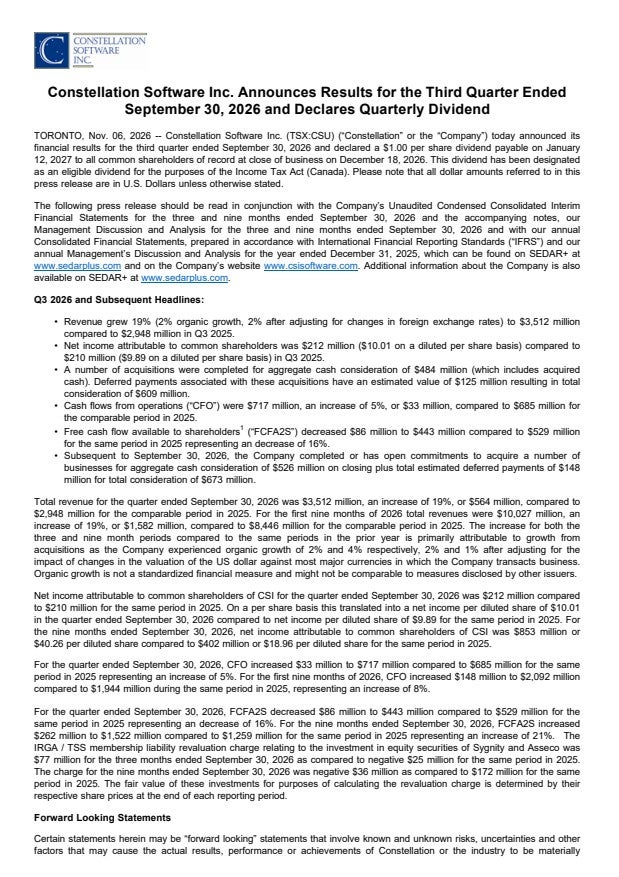
Q3 2026 Earnings Call Summary
The call was broadly positive. Revenue increased 19%, recurring revenue growth remained solid, operating cash flow rose 5%, acquisition activity was strong, acquisition cohorts were improving margins, and management highlighted extensive AI experimentation and progress on verticalization. These strengths were partly offset by a 10% decline in U.S. health care revenue, lower license and professional services revenue, a 16% reported decline in free cash flow available to shareholders, continued acquisition competition and resilient valuations, and limited evidence of broad-based customer AI demand.
Management said U.S. health care investments are “expected to perform to our IRR expectations that we underwrote,” with the two recently acquired businesses expected to shrink, while the broader group would have been down about 3% excluding them; recurring revenue organic growth was 4%, about 5% excluding U.S. health care businesses, and the historical series generally varies between 5% and 7%. Management said it would “maintain the same time line” for bringing acquired businesses onto the CSU model, while AI best practices “might accelerate” margin improvement but they are “not ready to say that yet”; acquisition cohorts moved from negative 16% margins to 27% and from 12% to 21%. Verticalization is “mostly through,” with more than half of revenue in verticalized buckets, and AI remains “still early,” with spend “not currently material to our results” and no forecast provided; M&A is “lumpy,” activity is ongoing, and management said “hopefully, it will continue.”
- Revenue GrowthThird-quarter revenue was $3.5 billion, up 19% year over year.
- Recurring Revenue GrowthOverall organic growth was 2%, while maintenance and other recurring revenue organic growth was 4% in the quarter. Management described the 4% recurring revenue growth as a reasonable outcome.
- Underlying Recurring Growth Excluding U.S. Health CareExcluding the U.S. health care businesses, particularly Altera, maintenance and recurring revenue growth would have been about 5%, generally consistent with the 5% to 7% range seen since 2016, except for 2020 when it was 1%.
- Cash From OperationsCash from operations was $717 million, up 5%.
- Free Cash Flow Adjustment ExplainedFree cash flow available to shareholders was $443 million, down 16%, primarily reflecting a $117 million quarterly revaluation charge related to the Topicus minority-partner obligation. Management stated that holding the charge flat, free cash flow would have been up about 3%. Approximately $77 million of the charge resulted from rising Sygnity and Asseco share prices, with the remainder reflecting growth in Topicus' recurring revenue.
- Noncash Nature of Topicus Revaluation ChargeManagement stated that the revaluation charge is noncash in the period and does not represent a deterioration in the business. The underlying obligation is settled through the transfer of Sygnity and Asseco shares rather than a cash payment.
- Strong M&A ActivityThe company reported being very busy through the first three quarters, with acquisition activity still ongoing. Management described the year-to-date capital deployment as strong and said the company has developed better capacity to complete larger and more complicated transactions.
- M&A Execution and Best-Practice SharingManagement said its M&A and business-development teams are doing an excellent job against competition, using knowledge accumulated throughout the company's acquisition history. Best-practice sharing in acquisitions was described as working very well.
- Opportunistic Acquisition StrategyAcquisitions remain opportunistic across geographies and verticals, with the company seeking niche businesses with a moat. For businesses outside traditional VMS markets, the company uses four-scenario models with more dispersion, including worse downside cases and somewhat better upside cases, to determine pricing.
- Improving Acquisition Cohort MarginsThe cohort of businesses acquired in the first quarter improved from negative 16% margins to 27%. The second-quarter acquisition cohort improved from 12% to 21%. Management said the businesses are improving, although the volume of acquisitions remains a drag on the overall result.
- AI Experimentation Across the PortfolioMore than 1,600 businesses across dozens of vertical markets are running AI experiments in products, customer support, and software development. Some experiments are already paying for themselves, while others are not. Management described the company as experimenting hard and moving quickly, while still being early.
- AI Best-Practice SharingManagement said AI best-practice sharing is occurring extensively across the decentralized organization and that results from the many experiments travel across businesses. Daan's appointment as Chief AI Officer is focused primarily on transmitting these best practices, and management said the role is intended to help operating leaders improve what they do rather than control their businesses.
- AI Spending Remains ImmaterialManagement stated that AI spending is not currently material to the company's results and that nobody at the company is waiting to be told what to do about AI.
- Verticalization Initiative Mostly CompleteThe company is mostly through its verticalization initiative, with only a few loose ends remaining. Management said the team has done a great job and that the initiative provides better focus. More than half of revenue falls into verticalized buckets, although some flexibility remains in how businesses are categorized.
- Healthcare Investments Still Meet Underwritten ReturnsManagement stated that all of the healthcare investments discussed, including the two recently acquired businesses experiencing shrinkage, are expected to perform to the IRR expectations underwritten at acquisition.
- Continued Healthcare Investment and Customer SupportThe company continues to invest in and support its healthcare customers. Management said healthcare investment decisions are made business by business and opportunistically, based on whether developing new products makes sense for shareholders' capital.
- Acquisition Integration Timeline MaintainedManagement said it would maintain the same timeline for bringing acquired businesses onto the Constellation model. The acquired businesses are also being infused with the company's AI best practices, although management is not yet prepared to say whether this will accelerate the timeline toward higher margins.
- Working-Capital Analysis Shows No ConcernsManagement said working-capital movements are substantially driven by timing and stated that its analysis of accounts receivable, work in process, and aging showed no concerns. The company also includes these working-capital effects in return-on-invested-capital calculations.
- Decentralized Succession ModelManagement said leadership transitions are usually smooth because successors have generally been with the company for a while. The decentralized structure creates a broad group of capital allocators and avoids single points of failure. Ramon will also take on additional shareholder and investor-relations responsibilities in his new role.
DE:W9C Earnings History
| Report Date | Fiscal Quarter | Forecast / EPS | Last Year's EPS | EPS YoY Change | Press Release |
|---|---|---|---|---|---|
| Feb 11, 2027 | 2026 (Q4) | 29.35- | 16.47 | ― | ― |
| Nov 06, 2026 | 2026 (Q3) | 26.6929.66 | 18.03 | 64.48% (+11.63) | |
| Aug 11, 2026 | 2026 (Q2) | 25.0628.49 | 22.9 | 24.42% (+5.59) | |
| May 12, 2026 | 2026 (Q1) | 22.6724.67 | 21.91 | 12.58% (+2.76) | |
| Mar 09, 2026 | 2025 (Q4) | 25.2516.47 | 33.1 | -50.23% (-16.63) | |
| Nov 07, 2025 | 2025 (Q3) | 23.1018.03 | 16.9 | 6.68% (+1.13) | |
| Aug 08, 2025 | 2025 (Q2) | 20.2522.90 | 7.63 | 200.09% (+15.27) | |
| May 12, 2025 | 2025 (Q1) | 18.5621.91 | 13.3 | 64.77% (+8.61) | |
| Mar 07, 2025 | 2024 (Q4) | 20.7133.10 | 15.39 | 115.05% (+17.71) | |
| Nov 08, 2024 | 2024 (Q3) | 17.6816.90 | 7.57 | 123.23% (+9.33) |
The table shows recent earnings report dates and whether the forecast was beat or missed. See the change in forecast and EPS from the previous year.
