


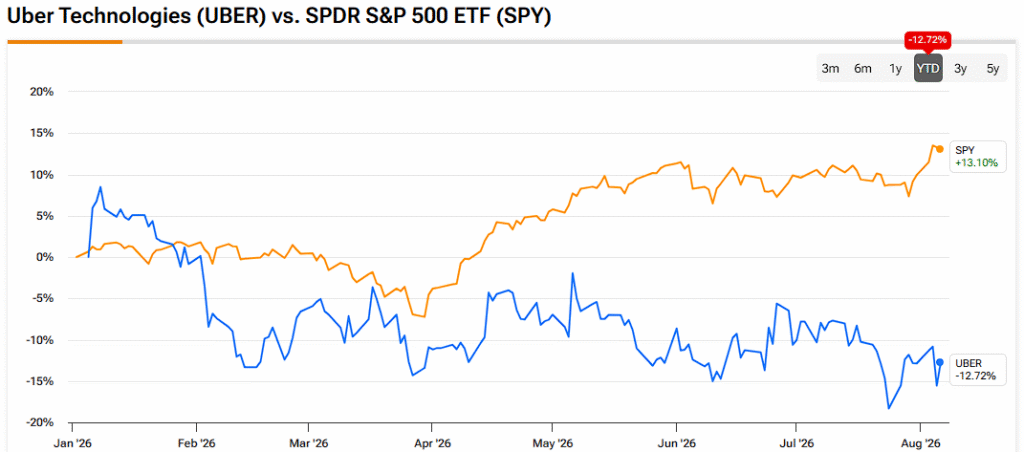
Uber Technologies (UBER) keeps delivering results that outrun its stock. Shares of the ride-hailing giant are down about 13% this year and almost 30% from their 2025 high. Yet Uber is still doing more trips, taking in more bookings, and generating more cash. Investors seemed to latch onto the small Q2 revenue miss, the softer profit outlook, and the likely cost of its robotaxi plans.
Summer Sale - Claim 70% Off TipRanks
- Unlock powerful investing tools with TipRanks Premium to make smarter, more confident investment decisions
- Subscribe to TipRanks Smart Investor Newsletter, and discover new investing opportunities with data-backed stock picks
Those are fair concerns. Still, the sell-off looks overdone to me, especially when the underlying business continues to improve. That disconnect is why my UBER stock forecast remains bullish.
Q2 Was Better than the Selloff
Uber’s Q2 results were better than the post-earnings sell-off implies. Revenue grew 12% year-over-year to $14.19 billion, narrowly missing the $14.24 billion consensus. Adjusted earnings per share (EPS) advanced 35% to $0.81 and edged past estimates. Wall Street disliked Uber’s Q3 EPS range of $0.84–$0.88, with the midpoint trailing the $0.89 consensus.
Yet gross bookings, the cleanest measure of marketplace activity, climbed 24% to $58 billion. That was almost $1 billion above expectations. Trips grew 18% to 3.9 billion. Also, first-time user additions were the strongest in five years.

Yet what caught my attention was the gap between bookings and revenue. Mobility bookings rose 22%, yet revenue barely moved, up just 1%. Uber had passed lower insurance costs back to riders through cheaper fares. So, I would not read much into that weak revenue number. If anything, lower prices helped activity.
Delivery also grew 28% to $5.24 billion, with demand holding up across markets and products. World Cup travel helped. However, the bigger point for me is that Uber’s businesses feed each other. Riders order food and subscribers tend to stay. Also, drivers move to wherever demand is.

The strength is showing up in cash flow, too. Quarterly free cash flow (FCF) hit a record $2.8 billion. This was up from $2.48 billion a year ago. GAAP net income of $2.39 billion included a $1.6 billion pre-tax investment-revaluation gain, so I would not annualize it.
Adjusted EPS growth and cash generation are the cleaner signals. Still, both say the ecosystem is converting higher activity into profit.
Uber Is Buying More Control
In the meantime, Uber is buying more control over delivery and autonomous supply. Its pending offer for Delivery Hero (DHER) is €41.50 per share in cash, valuing the target at $14.8 billion. Subject to shareholder and regulatory approval, closing is expected in the second half of 2027. Uber would acquire businesses in 50 markets that generated $42 billion of 2025 bookings, taking the combined footprint to 99 countries and $236 billion of pro forma bookings.
I believe the prize here is density. Markets offering both Mobility and Delivery would rise from 34 to 58, creating more chances to cross-sell Uber One. Uber should also be able to spread merchant-acquisition costs and keep couriers busier. Cross-platform users already generate roughly three times as many bookings and profit as single-product users. Uber sees immediate EPS accretion and high-single-digit percentage accretion by year three.
Integration and new debt are the risks associated with this transaction. Still, the separate sale of 14 overlapping markets should ease antitrust friction and keep monthly active customers on the rise.

The autonomous vehicle (AV) push is where I would agree Uber’s strategy gets more debatable. It already offers autonomous rides in seven cities and expects to reach 15 markets by year-end. Now it may commit over $10 billion to partner stakes and fleet support. One example is Rivian (RIVN), in which Uber could invest $1.25 billion and help put 10,000 exclusive R2 robotaxis on the road. There is an option to buy another 40,000 robotaxis by 2030.
I get the concern around depreciation and utilization. However, Uber is not developing the software or building the cars. It brings the riders, dispatch, payments, and fleet operations. Funding some vehicles may simply be the price of locking in capacity and keeping AV partners on its network.
Cash Flow Makes Uber Look Cheap
Cash flow makes Uber look cheap at today’s share price. Consensus calls for FCF of $10.58 billion in 2026 and $12.98 billion in 2027. That implies the stock is trading at 13.6x this year’s cash flow and 11.1x next year’s. These figures also imply yields of 7.3% and 9%. I believe those are modest multiples for a platform still growing bookings above 20%.
The stock appears cheap from an earnings point of view as well. Consensus EPS of $3.21 for 2026 places Uber at 21.9x earnings, while consensus EPS of $4.62 for 2027 places it at 15.3x earnings. In fact, the latter estimate implies about 44% growth. Also, note that more transactions can run across shared software, payments, support, and marketing infrastructure. This could allow profit to compound faster than revenue as margins improve.
There is a catch, of course. Vehicle capex could pull cash flow below consensus. Furthermore, Delivery Hero requires cash and debt. Also, Uber’s usual FCF number does not include acquisitions or equity investments.
So, yes, the earlier FCF figures I mentioned probably make near-term buyback capacity look better than it is. Then again, Uber is growing at a double-digit rate, and recreating its network would be extremely difficult.
Is UBER a Buy, Sell, or Hold?
Despite its lackluster returns, UBER stock continues to boast a Strong Buy consensus rating on Wall Street. This is based on 28 Buy ratings and three Hold ratings. No analyst rates the stock a Sell. Further, UBER’s average price target of $103.96 implies about 47% upside potential over the next 12 months.

Final Thoughts
Uber’s latest sell-off looks short-sighted, in my view. The business is adding users and deepening engagement. Also, Uber is converting more bookings into cash, all while the stock trades at a reasonable price. Delivery Hero and autonomous vehicles raise execution risks. However, they also widen Uber’s opportunity. If you are willing to be patient with the stock, the reward still appears worth the risk.