


SoFi Technologies (SOFI) continues to deliver unstoppable growth, creating strong upside potential, in my view. Second-quarter adjusted net revenue rose 40% to $1.21 billion and adjusted EBITDA climbed 44% to $358 million. A record 1.1 million members also joined the financial technology platform.
CEO Anthony Noto called the quarter a “clear inflection point”. Notably, 51% of new products were opened by existing members, evidence that the ecosystem is starting to feed itself. Yet, at today’s share price, SoFi remains roughly 44% below its 52-week high of $32.73 and trades at just over 30x 2026 adjusted earnings per share (EPS). For this reason, I remain bullish on the stock.
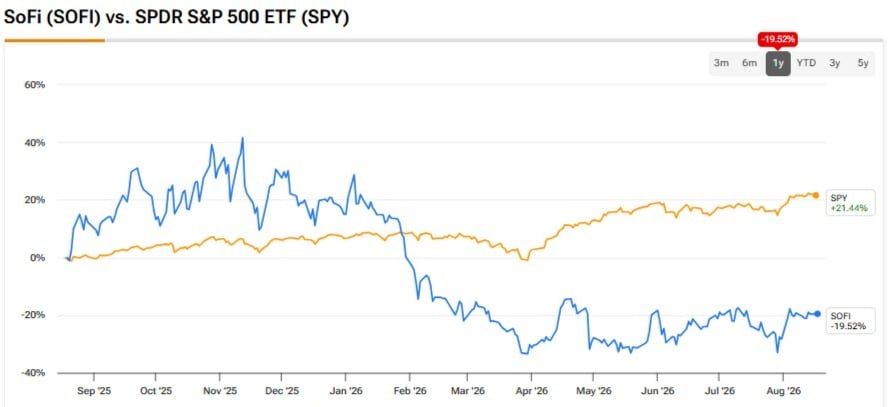
The Pullback Hides Relentless Growth
SoFi’s pullback hides its relentless growth, though it did not come out of nowhere. The stock was expensive going into the decline, and the December 2025 $1.5 billion equity raise put dilution concerns back on the table. Its exposure to unsecured personal loans remains another obvious worry. Then came Q2.
Management raised its revenue outlook but kept adjusted EBITDA guidance near $1.6 billion, which was not enough for the market. A 23% drop in Technology Platform revenue also stood out, even though the segment improved 13% from the previous quarter.
However, the broader quarter was outstanding. SoFi produced $157 million of GAAP net income, up 61%, while its adjusted EBITDA margin reached 30%. Members grew 35% to 15.8 million, and products grew 42% to 24.4 million, lifting products per member to a record 1.54. That cross-buy is quite noteworthy, as selling a second product to an existing customer is cheaper than finding a new one. It helped SoFi deliver its 19th consecutive Rule of 40 quarter, with a score of 70.
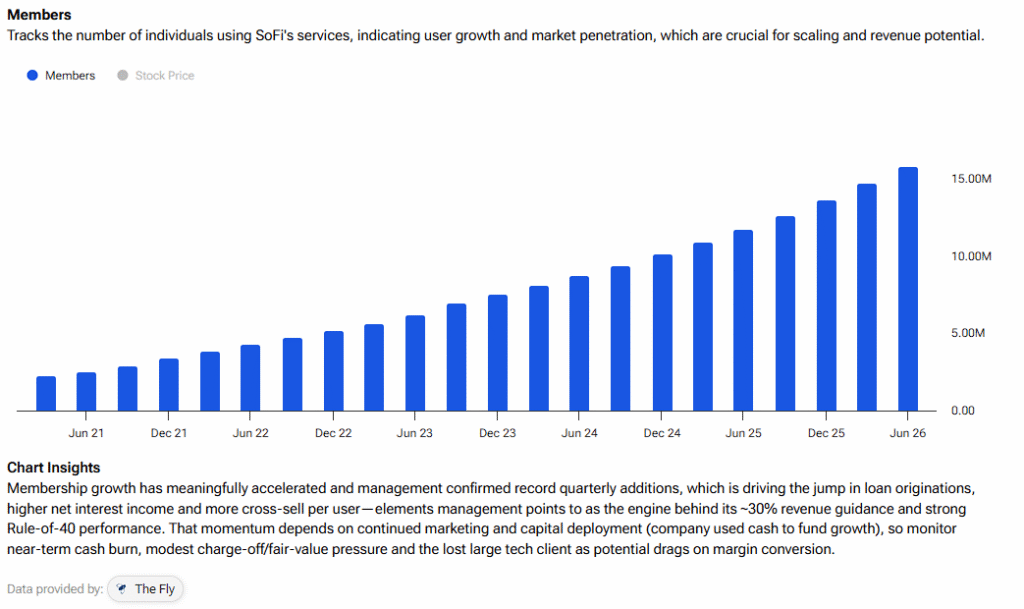
Growth was broad as well. Loan originations increased 69% to $14.8 billion, including record student-loan volume and 74% growth in home loans. Personal-loan charge-offs improved annually and sequentially to 2.62%. Net interest income rose 52% to $788 million and fee-based revenue reached $472 million, or 39% of adjusted revenue. This is increasingly evolving into a funding and fee story, which I really like, as it now starts to move away from the much narrower narrative of this being a bet on holding more loans.
SoFi’s Growth Still Has a Long Runway
Meanwhile, SoFi’s growth still has a long runway because each new member can deepen several revenue streams. Deposits climbed by $5.3 billion in Q2 to $45.5 billion. Management notes that using these deposits over warehouse funding generates roughly $713 million in annualized interest savings.
SoFi Plus now has more than 200,000 paying subscribers, while SoFi Coach has handled close to 500,000 conversations. Neither is huge on its own, but both should help keep customers around and bring them into more of SoFi’s products at little added acquisition cost.
Management is also building a more capital-light business. The Loan Platform Business generated $143 million of Q2 revenue and originated $3.1 billion of personal loans for partners, earning fees while outside capital holds the loans. SoFi is extending that machinery into small-business and home-equity lending. Composer, SoFiUSD, and Big Business Banking widen the funnel further. While not every launch matters, the direction is clear — more ways to monetize the same member relationship.

I believe that the new outlook backs this up. SoFi expects 2026 adjusted revenue of $4.75 billion to $4.85 billion, representing growth of 32% to 35%, while adjusted EPS guidance remains around $0.60. That flat profit forecast appears to be a choice. Management is spending heavily on marketing and new products now, even if it holds back near-term earnings.
The payoff should show up later. Much of the infrastructure is already in place, as selling another product to an existing member is cheaper. Further, deposits lower funding costs, and partner-funded loans require less capital. The Technology Platform remains the weak spot, but SoFi no longer depends on that business alone.
The Valuation Now Looks Cheap
At today’s depressed share price levels, I believe the valuation now looks cheap relative to the earnings path. At its current share price, SoFi trades at roughly 30.5x the $0.60 adjusted consensus EPS for 2026. That is not conventionally cheap for a lender, but SoFi is not delivering conventional lender growth. Consensus estimates point to about $0.82 in 2027, up 37%, followed by roughly 29% growth to $1.06 in 2028. Those figures reduce the multiple to about 22x and 17x, respectively, without the share price moving.
That is where I see the opportunity. If SoFi trades at a 25x multiple on $1.06 of 2028 earnings, then the implied value is $26.50. That is about 45% above the current price. A recession could lift credit losses, and spending may remain elevated. Also, SoFi’s Technology Platform growth could stay elusive. Yet Q2 showed improving credit and rising fee income. We also saw operating leverage. So, for a company capable of compounding adjusted EPS around 30%, a prospective 17x multiple looks mispriced, in my view.
Is SOFI a Buy, Sell, or Hold?
Despite the stock becoming increasingly cheaper lately, SOFI has a Hold consensus rating on Wall Street. This is based on six Buy ratings, six Hold ratings, and three Sell ratings. Also, SOFI’s average price target of $20.23 implies about 10% upside potential over the next 12 months. Clearly, the market remains cautious despite the company’s strong momentum.

Final Thoughts
SoFi certainly still carries credit and execution risk. However, it’s fair to say that the business is getting stronger by the quarter. Members are buying more products, and deposits are lowering funding costs. Fee revenue is also reducing capital intensity. With adjusted earnings potentially reaching $1.06 by 2028, today’s subdued valuation leaves meaningful room for upside. This is why my SOFI stock forecast remains bullish.