


Netflix (NFLX) stock is starting to look increasingly attractive, even as its growth slows down. Shares of the streaming giant have delivered a double-digit loss in 2026, trailing the broader market. This comes as the company faces lower revenue and earnings per share (EPS) growth, resulting in shares trading at a rare discount relative to the S&P 500 (SPX).
Summer Sale - Claim 70% Off TipRanks
- Unlock powerful investing tools with TipRanks Premium to make smarter, more confident investment decisions
- Subscribe to TipRanks Smart Investor Newsletter, and discover new investing opportunities with data-backed stock picks
Yet, this temporary stumble may present a buying opportunity, as workplace shifts driven by artificial intelligence (AI) could increase viewing hours. Ad-tier monetization is also now possible in more countries, leading to increased revenue.
I rate NFLX a Buy with an $82.1 per share 12-month price target, in line with the Strong Buy Wall Street consensus rating.

Why Are Netflix Shares Down in 2026
I believe a key reason behind the lackluster NFLX performance is the company’s slowing growth momentum. Case in point, while NFLX grew revenues at roughly 26% annually between 2017 and 2021, top-line expansion slowed to just 13.4% in Q2 2026. The fast-growth period until 2021 was a result of early adoption of Netflix services, which was supercharged as people spent more time indoors during the worst of the COVID-19 pandemic in 2020–2021.
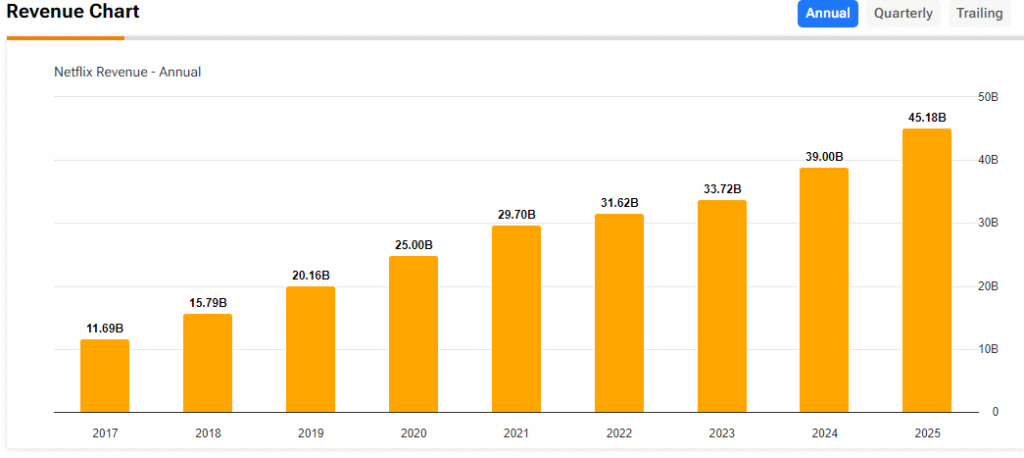
The company’s outlook shows that the recent trend is here to stay, with NFLX forecasting year-over-year revenue growth of about 11.7% in Q3 2026. With growth slowing, investors are paying increasing attention to the company’s earnings power and free cash flow generation. Indeed, these metrics are more relevant for mature companies after an early period of very strong revenue growth.
Q2 2026 Results Overview
NFLX reported Q2 2026 EPS of $0.80, an 11.3% year-over-year increase relative to Q2 2025. This is somewhat lower than the revenue growth rate of 13.4%, despite a roughly 2% boost from a lower share count due to share buybacks. Indeed, Netflix noted that Q2 2026 was its largest quarter of share buybacks in its history.
Unfortunately, with EPS growth lagging revenue expansion, we see that NFLX’s bottom-line performance has been impacted by margin pressures. This reflects primarily higher sales and marketing, as well as technology and development expenses. As a result, Netflix has to increase its spending in these categories even as revenue growth slows.
So while in the past customers flocked to Netflix and allowed the company to achieve robust operating margins, current performance shows that NFLX has to invest in marketing and product development to achieve incremental revenue growth.
On the cash flow front, NFLX generated free cash flow of just $1.5 billion, down both quarter-over-quarter and year-over-year. The silver lining is that the drop reflects one-off higher tax payments due to the termination of the deal to acquire Warner Bros. (WBD). What is more, NFLX maintains a $12.5 billion free cash flow outlook for the full year, indicating an acceleration in free cash flow generation in the rest of 2026.
Not All Doom and Gloom
With slowing revenue growth, weaker margins, and a notable slowdown in free cash flow generation, one may think the NFLX investment case is indeed broken. However, there are also positive developments that may lead to faster NFLX growth in the medium to long term.
For instance, as AI becomes more prevalent in workplaces, I believe people will work fewer hours without compromising their standard of living. This, in turn, will allow for more hours for entertainment, resulting in a tailwind for NFLX’s business. A telltale sign of this could be an acceleration of NFLX’s key view hours metric. Most recently, view hours increased 2% year-over-year in H1 2026.
While AI is arguably more of a long-term driver, more tangible medium-term catalysts may include ad-tier monetization. Netflix is trying to improve its ads offering by investing in technology and user data. Subsequently, this could allow the company to offer an ads-supported tier in more countries, generating revenue from users who are currently not on the platform.
So, while NFLX’s revenue and earnings momentum is clearly slowing, there remain incremental medium- and long-term catalysts that could turn around Netflix’s fortunes.
NFLX’s Valuation
Following the weak share price performance of 2026, NFLX stock trades at only 20x its 2026 earnings estimates of $3.59, with earnings projected to grow about 6% in 2027. This represents about a 7% discount to the S&P 500’s average multiple of 21.5x.
Given NFLX’s low double-digit revenue growth, I think this is quite attractive. What is more, NFLX has a net debt position of only $5 billion, which is an insignificant amount relative to the company’s roughly $300 billion market capitalization. I believe NFLX’s funding profile remains highly conservative, allowing management to pursue incremental share buybacks at attractive prices.
To conclude, I believe that after the recent pullback, NFLX stock is worth a Buy rating. It is true that revenue growth is slowing and the company has recently faced margin pressures. At the same time, NFLX remains a conservatively funded company growing well above the pace of inflation, potentially indicating that the discount relative to the S&P 500 is likely excessive.
My 12-month NFLX price target is $82.1 per share, reflecting a market-like 21.5x multiple on consensus 2027 EPS of $3.82. It is true that against the backdrop of continuing revenue growth and share repurchases, the consensus 6% EPS expansion next year looks rather low. That is offset by the relatively high 21.5x earnings multiple. In essence, even if earnings come in higher than expected, a lower valuation multiple will likely cap the stock near my $82.1 price target.
Wall Street’s Take
On Wall Street, Netflix earns a Strong Buy consensus rating based on 24 Buy and seven Hold ratings over the past three months. Most notably, not a single analyst sees NFLX stock as a Sell. Currently, the average Netflix stock price target is $96.27, implying a potential upside of about 34% over the next 12 months.

Conclusion
Netflix shares have delivered poor returns in 2026, with investors demanding a lower valuation as NFLX faces weaker revenue growth and margin pressures. At the same time, I believe the market is giving NFLX little credit for potential medium- and long-term growth catalysts, which could create a buying opportunity in NFLX stock.
Indeed, the NFLX forecast of $12.5 billion in 2026 free cash flow suggests the cash-generation slowdown may prove temporary. This, in turn, should allow the company to continue with share buybacks at attractive prices while maintaining a conservative funding profile.
In conclusion, I feel comfortable with my $82.1 per share 12-month price target, which, while somewhat lower than the Wall Street consensus average NFLX price target of $96.27 per share, confirms a Buy rating for NFLX shares.