


Dividend ETFs (exchange-traded funds) are investment vehicles that, as the name suggests, pool investor money to buy shares in dividend-paying companies. Dividend ETFs offer investors a simple way to gain diversified exposure to income-generating stocks while reducing company-specific risk. The definition of the “best” dividend ETF depends on an investor’s goals and risk tolerance. Dividend ETFs are particularly popular among investors seeking regular income and portfolio stability.
What Makes a “Best” Dividend ETF?
While it’s simple to conclude that investing in dividend ETFs is a safer way to secure your returns, choosing a “best” dividend ETF can be challenging. Many dividend ETFs are available, but comparing them based on dividend yield, total return, and portfolio quality is essential. Before getting into how to select the “best” dividend ETF, let us understand these basic terms.
Dividend yield shows how much cash a stock pays in dividends each year compared to its share price. For example, if a $100 stock pays $2 in annual dividends, its dividend yield is 2%.
Total return on an ETF shows the overall gain or loss from an ETF. This includes both share-price appreciation and dividends. For instance, if an ETF’s price rises 5% and it pays a 3% dividend, the total return is 8%.
Meanwhile, the quality of a dividend ETF refers to the quality of the underlying assets. In this case, it refers to the financial strength and sustainability of dividends paid by the portfolio companies. High-quality dividend ETFs typically invest in companies with strong earnings, healthy balance sheets, stable cash flow, and a history of consistently paying and growing dividends.
Which Are the Most Popular Dividend ETFs?
Using TipRanks’ Compare ETFs Tool, we compared the performances of eight of the most popular dividend ETFs. As seen from the chart below, J.P. Morgan Nasdaq Equity Premium Income ETF (JEPQ) carries the highest dividend yield of 11.27%. JEPQ invests in large Nasdaq-focused companies and uses covered calls to generate extra income. It aims to provide both regular income and long-term growth potential. Its top three holdings include Nvidia (NVDA), Apple (AAPL), and Microsoft (MSFT).
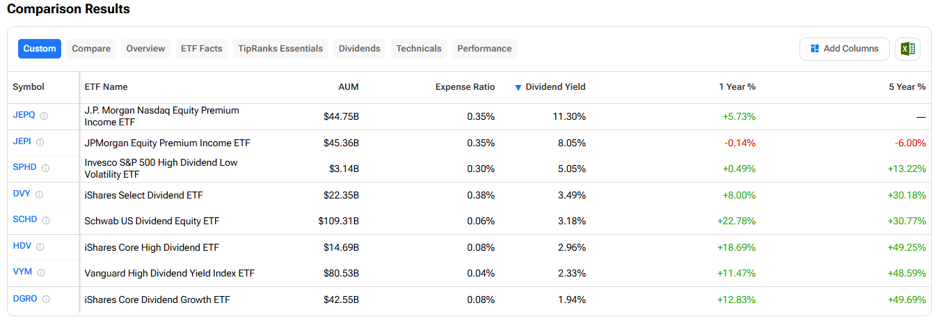
Source: TipRanks Data (as of October 9, 2026)
SCHD vs. VYM – One of the Most Searched Comparisons
Schwab US Dividend Equity ETF (SCHD) and the Vanguard High Dividend Yield Index ETF (VYM) are two of the most searched and compared dividend ETFs.
SCHD focuses on high-quality companies with strong dividend growth, while VYM provides broader exposure to dividend-paying stocks with higher yields. In simple terms, SCHD leans more toward quality and dividend growth, while VYM puts more emphasis on diversification and income.
SCHD currently offers a higher yield (3.18%) than VYM (2.33%), while the latter has historically delivered stronger total returns.
SCHD’s top three holdings include Texas Instruments (TXN), Qualcomm (QCOM), and Procter & Gamble (PG). Meanwhile, VYM’s top holdings are Broadcom (AVGO), JPMorgan Chase (JPM), and ExxonMobil (XOM).

Source: TipRanks Data (as of October 9, 2026)
How Do Monthly Dividend ETFs Perform?
Dividend payment schedules vary across ETFs. Some of the most popular monthly dividend ETFs include JPMorgan Equity Premium Income ETF (JEPI), JPMorgan Nasdaq Equity Premium Income ETF (JEPQ), and Global X Nasdaq 100 Covered Call ETF (QYLD).
These funds stand out because they use a covered call strategy to generate income. They own a portfolio of stocks and sell call options on those holdings, collecting option premiums that are distributed to investors as monthly dividends.
This strategy can provide attractive yields and help reduce portfolio volatility. However, it also limits potential gains during strong market rallies. JEPI focuses on lower-volatility, large-cap U.S. stocks, while JEPQ targets growth-oriented Nasdaq companies. QYLD writes call options on the Nasdaq-100, typically generating higher income but limiting upside potential.
How To Evaluate ETF Holdings Quality Using Analyst Ratings?
While finding dividend ETFs is easy, evaluating the quality of their holdings can be more difficult. TipRanks has created a unique way of analysing the quality of ETF holdings using Wall Street’s analyst ratings. TipRanks’ ETF analyst consensus is determined based on a weighted average of analyst ratings on its holdings.
For instance, if we compare the monthly dividend ETFs, we can see that all three ETFs have a Strong Buy consensus rating. However, QYLD offers a higher upside potential of 23.4% over the next twelve months. This is based on 89 Buys and 12 Hold ratings and an average price target of $23.06.

Source: TipRanks Data (as of October 9, 2026)
Tax Efficiency: Dividend ETFs in Taxable vs. Retirement Accounts
In the U.S., dividend ETFs can be taxed differently depending on where you hold them. In a regular brokerage account, the dividends you receive are usually taxed each year, which can lower your overall returns. Some dividends qualify for lower tax rates, while others are taxed as regular income.
In retirement accounts such as IRAs or 401(k)s, taxes are generally deferred until you withdraw the money. Roth accounts can be even more tax-friendly, allowing investments to grow and be withdrawn tax-free if certain rules are met. Because of these benefits, many investors prefer to hold high-yield dividend ETFs in retirement accounts to reduce their tax burden.
Building a Dividend Portfolio: Combining ETFs with Individual Dividend Kings
For income-seeking investors, building a well-balanced dividend portfolio involves combining ETFs with individual Dividend Kings. A Dividend King is a company that has consistently increased its dividend for at least 50 years.
A common approach is to build a dividend portfolio using dividend ETFs as the core and adding a few carefully selected Dividend Kings. Dividend ETFs offer diversification by investing in a broad range of companies that pay dividends, which can help reduce the risk tied to any single stock. At the same time, Dividend Kings have a long track record of consistently increasing their dividend payments. Together, they can provide regular income and greater portfolio stability. They also offer the potential for long-term growth. When evaluating Dividend Kings, investors should consider factors such as dividend growth, payout ratios, earnings stability, and diversification across sectors.
Reinvesting dividends can further boost long-term returns through compounding. Finally, investors should review their portfolios periodically to ensure their holdings continue to meet their income and growth objectives.
When NOT to Chase Yield: Warning Signs in ETF Distributions
A high dividend yield does not necessarily imply a good investment. Yields can also rise because the ETF’s share price has fallen, signaling potential problems. Below are some common red flags while investing in dividend ETFs:
- Yield is high because the share price has fallen sharply.
- Unsustainable distributions.
- Part of the distribution may represent a return of capital rather than income generated by the fund.
- Very high-yield ETFs are often heavily invested in sectors like energy, REITs, or utilities, which can increase risk.
- Heavy reliance on covered-call strategies that can limit upside potential.
To conclude, investors must not focus only on yield. They must also consider the ETF’s total return, dividend sustainability, portfolio quality, expenses, and long-term growth prospects. A 4% yield that grows over time is often better than a 10% yield that gets cut later.
How TipRanks can Help Select Good Dividend ETFs
TipRanks assigns ETFs a Smart Score based on the Smart Scores and ratings of their underlying holdings, helping investors assess overall portfolio quality. You can leverage TipRanks tools to build a robust dividend portfolio.
Score each ETF by the aggregate Smart Score and analyst consensus of its top holdings. This approach helps to verify the quality of the overall ETF and individual top holdings, that can sway the direction of returns.