


Meta (META) stock could come under further pressure as investors grow more concerned about the company’s aggressive superintelligence spending. Recent earnings results from its peers offer a warning. Alphabet (GOOGL) shares plunged after the company missed Q3 earnings expectations and reported negative free cash flow. Amazon (AMZN) also fell short of Wall Street’s earnings estimates of $1.96, reporting $1.89 earnings per share (EPS). With Meta committing billions to its superintelligence buildout and with the path to payoff remaining unclear, I expect the spending burden to weigh on its shares through year-end, keeping me bearish.
The social media giant behind Facebook, Instagram, WhatsApp, and Muse has seen its stock grow at a 21.4% average compounded annual growth rate (CAGR) since 2019. However, the market’s enthusiasm for the superintelligence trade is waning despite Meta’s consistently strong balance sheet and performance.
The bulls still have some ammunition, though. September’s release of its much-hyped agentic app, Muse, topped Apple’s (AAPL) App Store charts, boosting Meta’s share price to $779, a 30% bump for the month. Yet the stock has since retreated, up only about 1% from where it started in September. Additionally, S&P Global Ratings (SPGI) has readjusted Meta’s credit standing, citing negative cash flow and capex concerns.
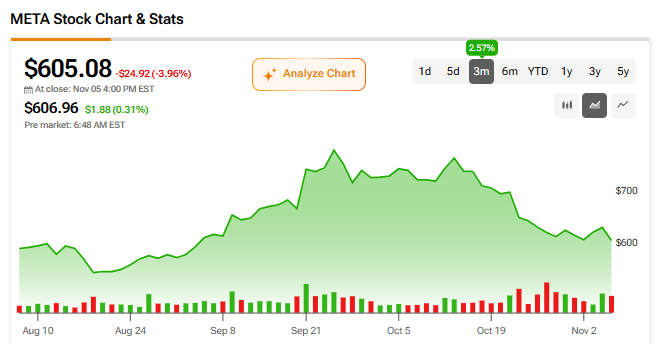
Where Is Meta Spending?
Meta’s 2026 total capex — driven primarily by its superintelligence buildout — is expected to reach $135 billion to $145 billion, following billions spent in 2024 and 2025. Looking ahead, S&P Global Ratings recently forecast Meta’s 2027 and 2028 capex spending will rise to $225 billion and $252 billion, respectively. This forecast has prompted S&P to adjust its AA- rating outlook from Positive to Negative
Meta’s Reality Labs division and settling lawsuits have also been a drag on financial performance. Reality Labs has launched popular Virtual Reality headsets and Smart Glasses. Meta’s upcoming gadget, the Muse Charm, could also be a holiday hit. So what’s the drag? Reality Labs continues to lose billions quarterly while revenue is only a few hundred million dollars. Not to mention the ongoing court cases that could make Meta liable for tens of billions of dollars.

Fast Growth, but Only in One Segment
Meta’s $200.97 billion in revenue is more than double what it was in 2020. Most investors are not concerned about the company’s ability to grow revenue.

Most investors are concerned about Meta’s ability to diversify its revenue. Advertising accounts for 97.6% of Meta’s revenue. Meta is an incredibly rich company that continues to spend an insane amount of money on products that generate very little revenue. On a positive note, it shows management’s willingness to take risks.

How Macroeconomic Factors Will Affect Superintelligence Spending
Macroeconomic factors will have an increasingly bigger impact on stock valuations until after the first half of 2027. Rising interest rates will make the cost of borrowing more expensive, and voter discontent over data centers swept through the U.S. midterms. One positive boost will come in the form of an Anthropic (ANT) initial public offering (IPO) in November, but some pessimism is showing in High Bandwidth Memory (HBM) names, neoclouds, and power equipment makers.
For example, neoclouds are feeling the heat after Democrats won both houses of Congress the day after the midterms. Rising energy prices and high water usage have been blamed on data centers. Stock prices for Coreweave (CRWV), Nebius (NBIS), and Iren (IREN) were down almost double digits in the two days following the election. Democratic Party wins have also pushed down power equipment makers’ share prices, with names GE Vernova (GEV), Siemens Energy (SMEGF), and Caterpillar (CAT) dipping in the short term. Anti-data center sentiment prompted Goldman Sachs (GS) to publish a report saying 45% of U.S. data center projects could be at risk because of politics.
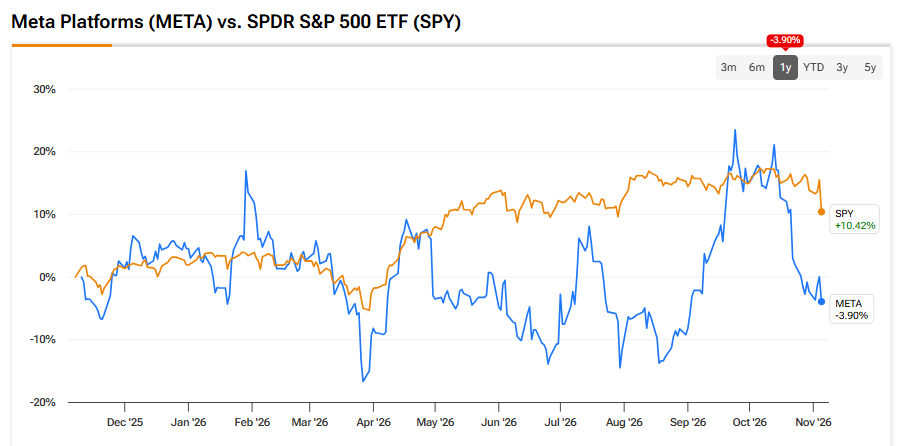
Advertising Revenue Masks Risks to Valuation
Meta’s strong Q3 year-over-year revenue growth of 26% beat Wall Street’s estimates, with over 97% of this revenue coming from advertising. Estimated Q3 EPS was $6.54, with reported EPS coming in at $3.83. The low reported number reflects a substantial payment to settle a lawsuit, giving bulls justification for focusing on the top line. Meta’s P/E of 20.78x is low compared with its Mag 7 counterparts.
Investors should monitor how Meta finances its superintelligence buildout, including its recent $20 billion bond sale and corporate actions like its planned 2-for-1 stock split in January 2027. With negative free cash flow and escalating spending, this could weaken the balance sheet and, consequently, the share price.
The -23.42 Moving Average Convergence Divergence (MACD) at a one-day interval has triggered a Buy score according to Technical Analysis, even while most Moving Averages show Sell. The MACD indicates recent volatility may have pushed META into oversold territory. Conversely, the Cboe Global Markets (CBOE) Volatility Index jumped to over 23 on November 5. This suggests market volatility has been unpredictable because of the superintelligence trade, and Meta’s negative Moving Averages support that view.

Analyst Forecast on META
Of the 43 analysts covering META, 37 rate it a Buy, six rate it a Hold, and zero rate it a Sell. The average 12-month price target of $859.32 implies a 42.02% upside from its last closing price of $605.08.
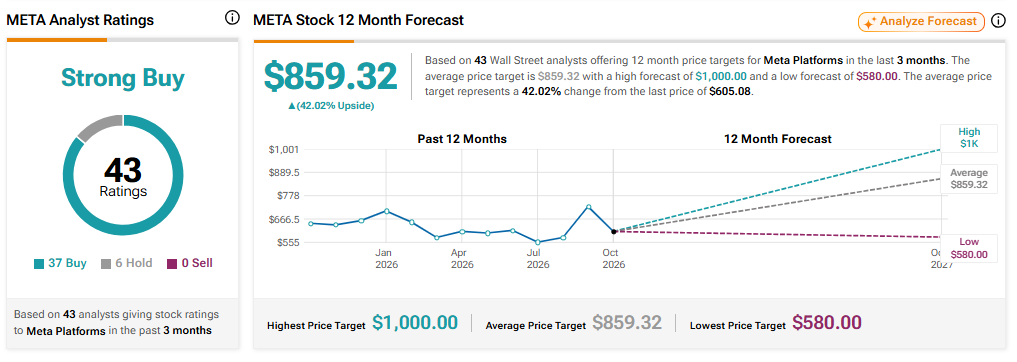
Truist Financial analyst Youssef Squali reiterated his Buy and raised his META price target from $763 to $1,000 per share.
Conclusion: Sour Public Sentiment Outweighs Benefits
Whether the negative public sentiment surrounding data center construction is warranted or not matters little in the near term, as investors will need time to assess potential new regulations. While the broader economic benefits of AI infrastructure outweigh short-term voter discontent, rising borrowing costs will add further pressure as the Fed begins its rate-hiking cycle. With trillions in planned industry spending and an uncertain timeline for profitable superintelligence monetization, Meta’s shareholder value could remain compressed over the next few quarters.