

Lockheed Martin (LMT) Q3 2026 Earnings Report
CH:LMT Q3 2026 EPS Results
- Actual EPS
- CHF 6.57
- Consensus EPS
- CHF 6.20
- Beat/Miss
- Beat by +CHF 0.37
- One Year Ago EPS
- CHF 5.73
CH:LMT Q3 2026 Revenue Results
- Actual Revenue
- CHF 17.08B
- Expected Revenue
- CHF 16.89B
- Beat/Miss
- Beat by +CHF 193.66M
- YoY Revenue Growth
- +11.30%
Earnings Announcement Details
- Quarter
- Q3 2026
- Date
- 10/22/2026
- Time
- Before Open
- Conference Call
- Thursday, October 22, 2026
Lockheed Martin's next earnings date is estimated for January 26, 2027, based on past reporting schedules.
Q3 2026 Earnings Call Audio
Q3 2026 Earnings Slide Deck
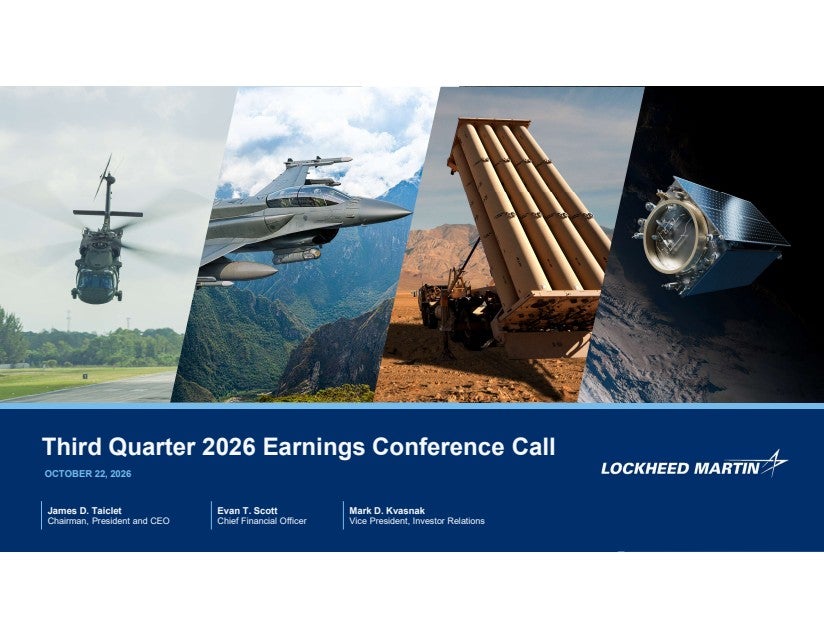
Q3 2026 Earnings Call Summary
The call was strongly positive, characterized by double-digit sales and profit growth, record backlog, robust free cash flow, broad-based demand, multiple raised full-year outlooks, and accelerating munitions and technology investments. The main challenges were the delayed timing of some F-35 awards, flat quarterly Space profit, funding uncertainty from the continuing resolution, unfinished contract terms, and an expected pension contribution exceeding $1 billion in 2027. Highlights significantly outweighed the lowlights.
For 2026, Lockheed Martin expects sales of between $80 billion-$82 billion, representing full year growth of approximately 8% at the midpoint; segment operating profit of between $8.575 billion and $8.675 billion; cash from operations between $10 billion and $10.2 billion; and free cash flow between $7.8 billion and $8 billion. Aeronautics is guided to sales of $31.1 billion-$32.5 billion, profits between $2.92 billion and $2.95 billion, and sales growth in the mid-single digits, between 3% and 7% year-over-year; MFC to sales between $17.25 billion and $17.45 billion, profit between $2.395 billion and $2.425 billion, and about 20% year-over-year growth in both; RMS to sales between $17.7 billion and $18 billion, growing in the low single digits year-over-year, and profit between $1.88 billion and $1.9 billion; and Space to sales between $13.95 billion and $14.05 billion, growing between 7% and 8% year-over-year, and profit between $1.38 billion and $1.4 billion, excluding any ULA equity earnings for the fourth quarter 2026. MFC expects mid-teens sales CAGRs over the next five years, while for 2027 the company expects all four segments growing next year on a top-line basis and high single-digit revenue growth next year as a company; a pension contribution in excess of $1 billion may be required next year.
- Record Backlog and Broad-Based DemandBacklog reached a record $292 billion, up $113 billion from the third quarter of 2025, with a 4x book-to-bill ratio. Demand was broad-based across all four segments, including PAC-3, C-130J, GMLRS, JASSM, LRASM, F-35, Black Hawk, and Fleet Ballistic Missile awards.
- Double-Digit Quarterly Sales and Profit GrowthThird-quarter sales rose 11% year-over-year to $20.7 billion, while segment operating profit was $2.2 billion with a 10.8% operating margin. Earnings per share increased 15% year-over-year to $7.97 from $6.95, primarily due to higher segment operating profit.
- Strong Cash GenerationCash from operations was $3.4 billion in the quarter and $6.9 billion year to date. Free cash flow was $3 billion in the quarter and $5.6 billion year to date, primarily driven by improved working capital and customer receipts in Aeronautics, MFC, and Space.
- Full-Year 2026 Guidance Raised AgainThe company raised its 2026 outlook to sales of $80 billion-$82 billion, representing approximately 8% growth at the midpoint; segment operating profit of $8.575 billion-$8.675 billion; cash from operations of $10 billion-$10.2 billion; and free cash flow of $7.8 billion-$8 billion. The increase reflects higher MFC munitions volume, stronger program performance, improved execution, solid collections, improved working capital, and continued favorability from IRS tax guidance.
- Aeronautics Quarterly Growth and F-35 MomentumAeronautics third-quarter sales increased 13% year-over-year and segment operating profit increased 9%, driven by higher F-35 volume and recovery of C-130 pre-contract costs. The F-35 multi-year agreement establishes a path to 850 U.S. aircraft over 10 years, augmented by allied sales, with total production of 156 aircraft per year for 10 years. F-35 production was described as accretive to Aeronautics and Lockheed Martin margins.
- MFC Production Ramps Ahead of ScheduleMissiles and Fire Control sales and profit each increased 24% year-over-year in the quarter as munitions production ramps progressed ahead of schedule. The company expects MFC sales of $17.25 billion-$17.45 billion and profit of $2.395 billion-$2.425 billion in 2026, with both sales and profit expected to grow about 20% year-over-year.
- MFC Long-Term Growth FrameworkManagement stated that MFC is expected to achieve mid-teens sales CAGRs over the next five years, supported by firm backlog and the conversion of additional heads of agreement into long-term contracts.
- RMS Growth in Radars and Command and ControlRotary and Mission Systems third-quarter sales increased 3% year-over-year, driven by radars and command and control programs, while segment operating profit increased 4%, benefiting from the favorable resolution of a contracting matter. Full-year 2026 sales are expected at $17.7 billion-$18 billion, with operating profit of $1.88 billion-$1.9 billion.
- Space Segment Growth and Improved OutlookSpace third-quarter sales increased 4% year-over-year, driven by Next Generation Interceptor and Fleet Ballistic Missile. Full-year 2026 sales are expected to grow 7% to 8% year-over-year to $13.95 billion-$14.05 billion, while profit expectations increased to $1.38 billion-$1.4 billion.
- C-130J and International AwardsThe company booked $4.4 billion in C-130J contracts for 34 new production aircraft serving U.S. and international partners. It also received a $439 million Army Tactical Missile System production contract for Taiwan's HIMARS launchers and was selected to establish Australia's combat systems integration capability for future Virginia-class submarines, a program expected to span decades.
- F-35, PAC-3, and THAAD Contract VisibilityThe PAC-3 seven-year contract brought the total potential value of the PAC-3 multi-year contract to $58.6 billion. Together with the seven-year THAAD contract signed earlier in the year, these agreements provide long-term volume visibility for Lockheed Martin and its suppliers.
- Expansion of Munitions Capacity and WorkforceThe company plans to add 2 million square feet of facilities across eight sites over the next three years, with more than half already underway or under construction. MFC is hiring and training over 3,000 new team members this year, supported by partnerships with local communities, technical schools, and colleges.
- More Than $8 Billion Munitions InvestmentLockheed Martin is making more than $8 billion in investments through 2030 to modernize more than 20 facilities, expand its supply chain, and grow its workforce. Management described this as one of the largest commitments to munitions production in the company's history and said the expansion is ahead of schedule.
- Supplier Expansion and Production SupportThe company placed new supplier contracts for PAC-3 and THAAD, including a $4.7 billion L3Harris PAC-3 propulsion contract. After quarter-end, it awarded Boeing a $14.7 billion contract to triple PAC-3 seeker production and Northrop Grumman a $1.6 billion contract for propulsion and other missile components. Nearly 750 suppliers across 42 states support THAAD, and management said longstanding production bottlenecks are being resolved.
- PrSM, JATM, and Missile Development ProgressPrecision Strike Missile Increment 2 advanced from flight tests in March and August to a $1.2 billion production contract within the same year. The company also signed a framework agreement to accelerate Joint Advanced Tactical Missile production, with Australia committed as the first international customer.
- Vectis Autonomous Aircraft DevelopmentThe Vectis team progressed from first drawing to wind tunnel testing in under two months and released its first production part in eight months. Flight demonstrations are scheduled for next year, and Lockheed Martin plans to build five Vectis aircraft using its own investment.
- Advances in Autonomy and AIThe X-62 VISTA completed 27 AI-controlled intercepts across eight flights using live data from the Legion sensor pod, with full integration completed in three months. Sikorsky also completed initial flight testing of the uncrewed Nomad 100, while Lockheed Martin's MATRIX autonomy was selected for all five aircraft competing in the DARPA fly-off.
- Missile Defense and Hypersonics ProgressThe company completed a key solid rocket motor test for the Next Generation Interceptor, keeping the program on track for fielding by 2030. PAC-3 Edge advanced to the next stage of development for the Army's Future Interceptor program, and the Long-Range Hypersonic Weapon was fielded during an exercise.
- Integrated Defense and Command-and-Control CapabilitiesAt Valiant Shield, the RMS team used the CommandIQ software-driven command-and-control system to connect long-range missiles, integrated air and missile defense, and remote targeting, with AI recommending target engagements. The company also developed an AI-enabled battle management prototype for Guam and was selected by the Missile Defense Agency to move missile defense modeling and simulation to the cloud.
- International AIR 6500 AwardLockheed Martin received an $800 million contract for the next tranche of Australia's AIR 6500 joint air battle management system, demonstrating international demand for its integration capabilities.
- Manufacturing and Commercial PartnershipsGM Defense delivered its first PAC-3 components in under one month from the initial contract. Lockheed Martin is expanding its Grand Prairie, Texas, manufacturing footprint to more than 735,000 square feet, adding automation and digital manufacturing capabilities and a Hadrian automated production machine cell.
- Engineering and Digital TransformationManagement described three changes to the engineering culture: mission technology roadmaps integrated with product roadmaps, model-based engineering and production through the 1LMX digital twin and digital thread, and increased R&D spending to build prototypes before government requests for information or proposals.
- Research, Development, and Venture InvestmentsYear to date, Lockheed Martin invested $1.3 billion in capital expenditures and $1.6 billion in independent research and development, with the largest share directed toward munitions capacity. The company is partnering with IBM to establish a quantum innovation hub in Switzerland and allocated $100 million of its expanded venture fund to companies in the U.K. and Europe.
- Dividend Increase and Balance Sheet FlexibilityThe board increased the quarterly dividend by $0.15 to $3.60 per share, marking the 24th consecutive year of dividend increases. Management said the balance sheet remains strong and provides flexibility for strategic investments.
- Ultra Maritime Acquisition on TrackThe Ultra Maritime acquisition remains on track to close in the fourth quarter after all required regulatory approvals were cleared. The transaction is expected to be funded with cash on hand and is not yet included in the 2026 outlook.
- Positive 2027 Revenue VisibilityAlthough specific 2027 guidance was not provided, management expects all four segments to grow on a top-line basis next year and sees clear line of sight to high single-digit revenue growth for the company.
- Contract Structure Supports Cash NeutralityFor munitions production ramps, management said the customer is ensuring cash neutrality during the investment phase. The framework agreements include cash-flow protections, inflation-based annual escalators, and recovery mechanisms if future administrations or Congress reduce agreed volumes or duration.
CH:LMT Earnings History
| Report Date | Fiscal Quarter | Forecast / EPS | Last Year's EPS | EPS YoY Change | Press Release |
|---|---|---|---|---|---|
| Jan 26, 2027 | 2026 (Q4) | 6.88- | 4.78 | ― | ― |
| Oct 22, 2026 | 2026 (Q3) | 6.206.57 | 5.73 | 14.68% (+0.84) | |
| Jul 23, 2026 | 2026 (Q2) | 5.936.55 | 1.2 | 443.84% (+5.34) | |
| Apr 23, 2026 | 2026 (Q1) | 5.565.31 | 6 | -11.54% (-0.69) | |
| Jan 29, 2026 | 2025 (Q4) | 4.804.78 | 1.83 | 161.26% (+2.95) | |
| Oct 21, 2025 | 2025 (Q3) | 5.275.73 | 5.64 | 1.61% (+0.09) | |
| Jul 22, 2025 | 2025 (Q2) | 5.381.20 | 5.86 | -79.47% (-4.66) | |
| Apr 22, 2025 | 2025 (Q1) | 5.236.00 | 5.22 | 15.01% (+0.78) | |
| Jan 28, 2025 | 2024 (Q4) | 5.461.83 | 6.52 | -71.90% (-4.68) | |
| Oct 22, 2024 | 2024 (Q3) | 5.365.64 | 5.58 | 1.03% (+0.06) |
The table shows recent earnings report dates and whether the forecast was beat or missed. See the change in forecast and EPS from the previous year.
