


With the market headlines focused on artificial intelligence (AI) trades, Visa (V) is the hidden gem that steadily compounds while consistently returning capital to shareholders. Visa recently reported that dividends and buybacks over the past five years equaled 85% of free cash flow. It is the largest payment processor globally, operating in more than 200 countries and processing almost twice as many transactions as Mastercard (MA) annually.
I am bullish on this stock because the company has strong financials and clear plans for future growth, while its risks appear manageable over the foreseeable future.
Visa’s Financial Position
First, let’s consider Visa’s financial position. On April 28, 2026, Chris Suh, the CFO, stated on the earnings call, “In Q2, we bought back $7.9 billion in stock, the highest quarterly buyback in Visa’s history.” Visa reported paying $1.3 billion in dividends, and at the end of March, had $13.2 billion remaining in buyback authorization. In April, the board authorized a new $20 billion multi-year repurchase program.
Visa pays a quarterly dividend of $0.67, resulting in a dividend yield of 0.80%, and has increased its dividend consecutively for 17 years. A dividend yield of 0.80% is considered low since typical ranges fall between 1.3% and 1.5%; however, Visa offsets the low yield by reinvesting in growth. The stock’s price appreciation has historically outpaced its dividend.
Visa does not need balance sheet leverage or physical assets to grow. According to consensus estimates, gross and net revenue are projected to grow at compound annual rates of 11% and 10% over the next five years. This aligns with Visa’s recently raised full-year outlook, where management boosted its adjusted, constant-dollar expectations on the back of strong cash generation and healthy operating margins.
Visa’s Financials Fund the Agentic AI and Stablecoin Future
Visa’s projected five-year compound annual growth rates and raised outlook are increasingly tied to its expansion into agentic AI commerce and stablecoin infrastructure. Specifically, in Q2, management said U.S. payment volume grew 8% year-over-year. It also mentioned e-commerce outpaced in-person spend. Both discretionary and non-discretionary spending remained strong, with no weakness among lower-spend consumers.

Visa’s value-added services (VAS) business model extension allows the company to be involved whenever money moves, even when the use case is not a traditional card purchase. VAS gives Visa a way to monetize beyond basic payment volume. Management views AI and agentic commerce as major catalysts for digitizing global commerce and driving more transactions. It can also enable microtransactions, automate B2B payments, and add an estimated 80 to 150 basis points of incremental growth into global GDP.
Visa recently formalized a partnership with OpenAI for agentic commerce and is currently developing stablecoin rails since agents will need tokens paired with payment credentials, identity verification, fraud protection, and dispute-handling protocols to transact securely. If Visa successfully establishes stablecoin infrastructure for agentic AI, revenue could grow due to an increase in microtransaction volume. Even if the total dollar amount spent stays the same, the increased volume of network traffic will require data processing and result in value-added service revenue for Visa.
Valuation
When evaluated against its direct peers, Visa’s valuation reveals a compelling relative-value positioning. Trading at about 30.6x trailing 12 months (TTM) P/E, Visa commands a structural premium over American Express (AXP), which trades at about 21.72x, reflecting the market’s preference for Visa’s pure-play network model over Amex’s credit-exposed lending structure. Notably, Visa trades close to its duopoly counterpart, Mastercard, which is trading at a TTM P/E of about 30.20x.
Given that Visa’s net revenues are projected to compound at a healthy 10% rate over the next five years, this minor discount to Mastercard suggests that Visa is fundamentally well-priced within the payment rails space, offering top-tier network stability without the premium multiple typically commanded by its peer. Visa also currently carries a TipRanks Smart Score of 8.

Risks Surrounding Visa
Although the bull case is compelling, there are several risks surrounding Visa, given that agentic AI and stablecoin rails are still in their early stages. Visa does not issue cards or take on consumer credit risk; however, its business model is tied to consumer purchasing. Visa earns fees from transaction volume and payment processing, so any economic downturn or reductions in consumer spending could impact revenue. Although Visa’s Beta of 0.73 indicates it isn’t overly sensitive to the macro environment, it is still a risk to be aware of.
Another risk worth noting is new developments in payment rails. Due to Visa’s scale and network effects, stablecoin startups aren’t a significant risk to Visa. The real concern is governments and regulations. Governments can favor domestic payment systems by picking and choosing rails. For example, in China, they use WeChat and Alipay, not Visa. Future growth will need to come from standard payment volume, emerging markets, and new payment use cases. Restrictions from emerging markets on Visa use would impact future growth.
With that said, stablecoin rails need consumers, merchants, banks, and compliance policies. This will benefit Visa because consumers already use it and merchants already accept it. This makes rail replacement difficult, even when alternatives are cheaper or faster in some cases.
Being a hard-to-replace incumbent creates a lot of friction with merchants, though. Litigation expenses are a persistent issue, but the expansion of stablecoins could offer merchants alternatives. This has the potential to reduce legal expenses for Visa. A comparable example is Google (GOOGL), which was found liable for illegal monopolization but avoided a forced breakup after the courts deemed AI competition reshaped the market.
Visa on Wall Street
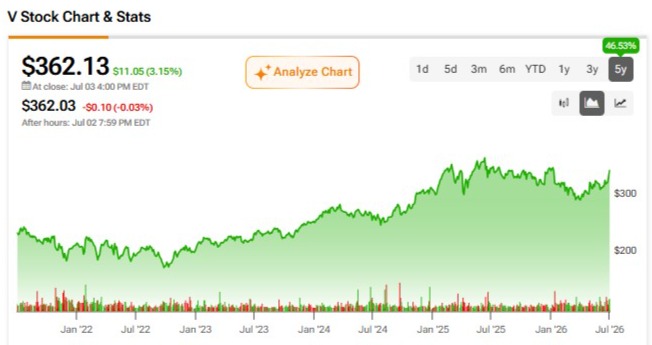
Visa has a Strong Buy consensus rating on Wall Street, based on 22 Buy ratings and three Hold ratings. No analyst rates the stock a Sell. Despite its stretched valuation, Visa’s average price target of $391.18 represents approximately 8% upside potential over the current price of $362.13. According to TipRanks, retail investor sentiment is Very Positive, blogger sentiment is broadly Bullish, and news sentiment shows Very Positive, slightly above the sector average.

The Bottom Line
Visa has a dominant market position with predictable demand, low capital expenditures, and strong cash return. The moat remains intact and should continue to compound as it always has. Given its current financial position and future growth potential, Visa is in a good position to hit the average price target set on Wall Street.