EV maker Tesla (TSLA) enters August with a market value of roughly $1.23 trillion. This means that investors are still assigning a very high value to its robotaxi and robotics businesses, even though they are still in their early stages. Importantly, second-quarter revenue rose 26% from a year earlier to $28.24 billion as vehicle deliveries reached a quarterly record of 480,126. However, adjusted earnings fell 18% to $0.33 per share, while Tesla’s operating margin dropped to only 1.4%.
Summer Sale - Claim 70% Off TipRanks
SPCX has a long & short ETF? Explore SPCM & SPCGAs a result, the stock’s next big move may depend on whether Tesla can protect its car business while turning self-driving technology and energy storage into larger sources of profit.
Catalysts that May Push the Stock Higher
To begin with, Tesla’s most obvious near-term opportunity is a continued recovery in vehicle demand. Deliveries rose 25% from last year and were more than 28,000 vehicles higher than production. This helped Tesla reduce the number of unsold cars sitting in inventory. At the same time, sales from the company’s Shanghai factory, including exports, increased by roughly one-third. Demand also improved in Europe. If this continues, Tesla could return to annual delivery growth after two straight years of declines.
Separately, Full Self-Driving is becoming more important as well. In fact, active subscriptions increased 56% to 1.48 million, while more than 55% of new North American deliveries included an FSD subscription. Tesla has also grown its robotaxi service and reported 2.5 million paid miles. Of those, 380,000 miles were completed without a safety monitor sitting inside the vehicle.
Meanwhile, energy storage gives Tesla another source of growth that does not depend on car sales. The company deployed a record 13.5 gigawatt-hours of storage products during the quarter, up 41% from last year. Demand is being supported by utilities and data centers that need more battery capacity. Tesla’s services and other business also grew quickly, with revenue rising 50% and gross profit reaching a record $648 million.
Risks to Watch Out For
However, Tesla does come with risks. The biggest concern is that Tesla’s growth is becoming much more expensive. For example, capital spending jumped by 142% to $5.79 billion during the quarter, which pushed free cash flow to negative $1.09 billion. At the same time, total gross margin fell to 16.8%, while operating expenses increased by 47% as Tesla spent heavily on AI and other research projects.
Tesla must also prove that robotaxis can grow safely and make money. However, several Tesla robotaxi service areas are limited at the moment. In addition, competition in China creates another risk because local companies are selling newer vehicles at aggressive prices. Finally, reports of a possible SpaceX (SPCX) merger have added uncertainty around Tesla’s important Chinese business, although Elon Musk has denied that plans are being made to separate those operations.
What Is the Prediction for TSLA Stock?
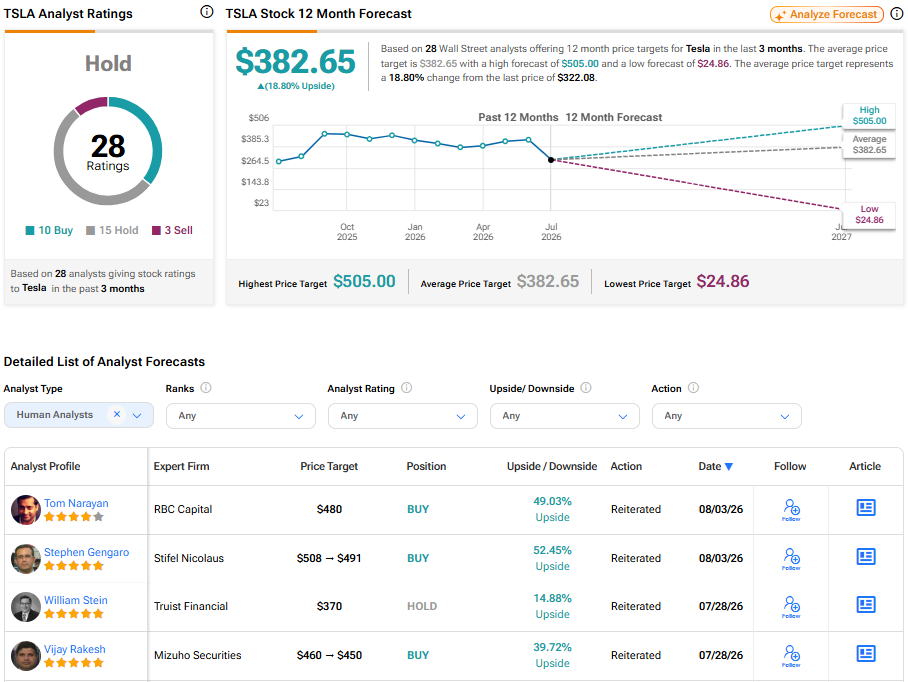
Turning to Wall Street, analysts have a Hold consensus rating on TSLA stock based on 10 Buys, 15 Holds, and three Sells assigned in the past three months, as indicated by the graphic below. Furthermore, the average TSLA price target of $382.65 per share implies 18.8% upside potential. (See TSLA Stock Forecast).