Electric vehicle maker Tesla (TSLA) has reported eight Cybercab crashes to federal regulators less than three months after it began offering public robotaxi rides in Austin on September 3. Four crashes happened while the vehicles used Tesla’s automated-driving system at speeds of 5 mph or less. The other four occurred during tests with a driver behind the wheel, including a highway collision at 53 mph. Two of the eight crashes also involved minor injuries.
According to Electrek, the National Highway Traffic Safety Administration records these incidents in two separate categories. The first covers vehicles operating under automated control. In one incident, a Cybercab drove into a water-filled pothole in an Austin parking lot. Another drove over a raised concrete edge. The remaining two involved other vehicles hitting Cybercabs that were stopped.
The second category covers tests where a driver is present, and Tesla’s driver-assistance system is active. These crashes were more serious. One Cybercab hit an SUV at 5 mph in Austin, which resulted in a minor injury and hospitalization. Another struck an SUV at 11 mph in Lehi, Utah, which caused a minor injury without hospitalization. Meanwhile, a Cybercab was involved in a crash while stopped in Tampa.
However, Tesla kept the detailed descriptions of all four supervised crashes confidential. As a result, the public records do not establish who was responsible or whether Tesla’s software caused any of them.
Why Tesla’s Robotaxi Speeds Matter
The difference in crash speeds is important because Tesla’s public Robotaxi service mainly operates at lower speeds. Of the 43 crashes reported under Tesla’s automated-driving system, the median speed was just 1 mph. The highest was 29 mph, and none happened on highways.
That helps explain why the reported automated-driving crashes have generally been minor. However, these results do not show how safely the same system would perform at higher speeds, where collisions can have more serious consequences.
Tesla’s October 21 safety report stated that its Robotaxi fleet traveled 3.11 million miles without injuries in crashes where its vehicles made the first contact. That figure covered unsupervised driving through October 18. It excluded trips with safety monitors and supervised Cybercab tests.
Tesla also reported that unsupervised Robotaxi mileage increased eightfold during the third quarter, when Cybercab joined the Austin fleet. However, the mileage figures include other Tesla vehicles, which means that the Cybercab’s individual crash rate cannot be calculated from the eight reported incidents alone.
What Is the Prediction for TSLA Stock?
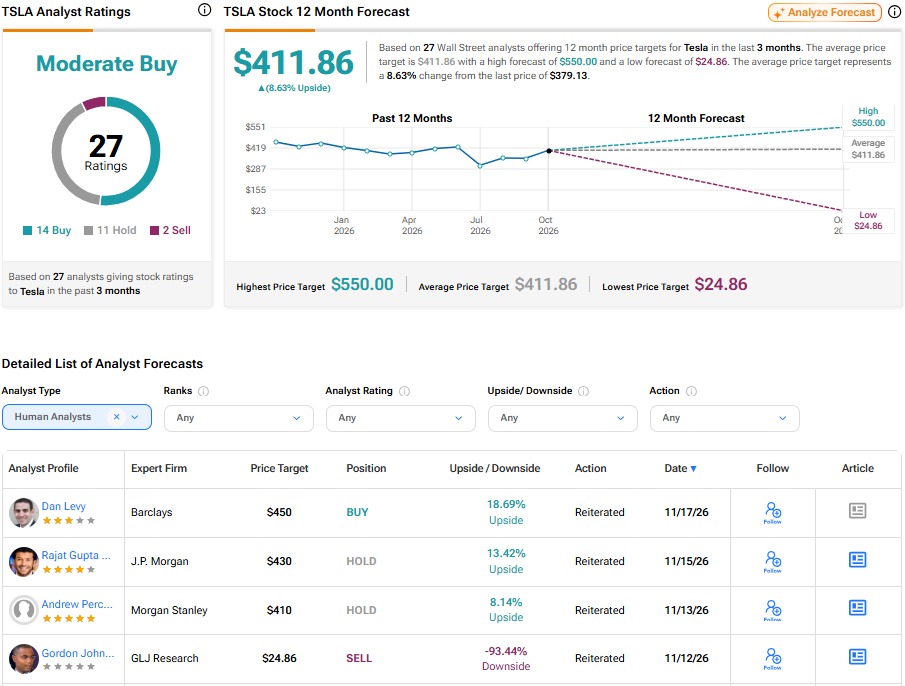
Turning to Wall Street, TipRanks data shows that analysts have a Moderate Buy consensus rating on TSLA stock. This is based on 14 Buys, 11 Holds, and two Sells assigned in the past three months. Furthermore, the average TSLA price target of $411.86 per share implies 8.6% upside potential. (See TSLA Stock Forecast).