


Semiconductor stocks have been among the biggest winners in recent years, fueled by surging demand for AI data centers, cloud computing, and high-performance chips. Investors may find it difficult to select individual stocks that offer lucrative returns. Hence, they can gain a diversified exposure to the sector by investing in exchange-traded funds (ETFs).
The VanEck Semiconductor ETF (SMH) and the Roundhill Memory ETF (DRAM) both invest in semiconductor companies, but they take very different approaches. Here’s a closer look at each fund to see which may be the better fit.
VanEck Semiconductor ETF (SMH)
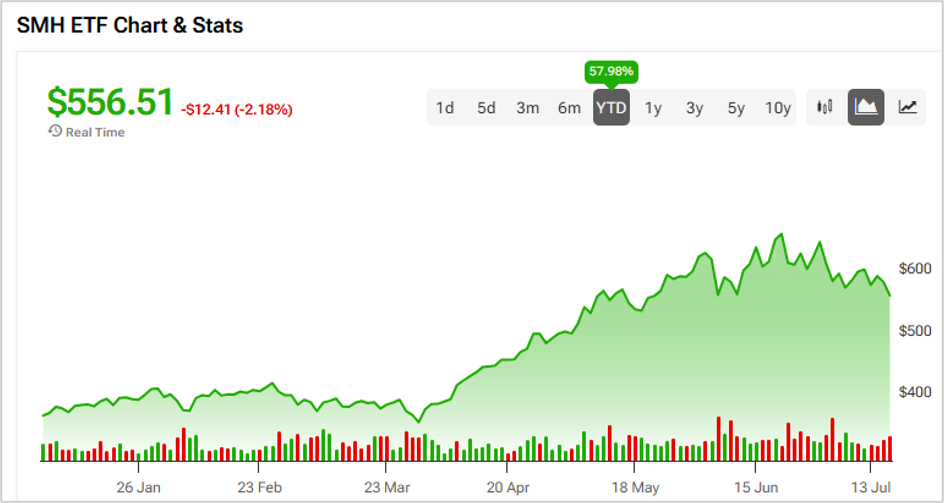
The VanEck Semiconductor ETF (SMH) provides broad exposure to many of the world’s largest chipmakers. SMH is well suited for investors seeking diversified exposure across the industry. The fund benefits from several long-term trends, including AI infrastructure spending, cloud computing, automotive chips, and industrial electronics. Year-to-date, SMH ETF’s price has surged nearly 58%.
SMH’s top five holdings include industry leaders such as Nvidia (NVDA), Taiwan Semiconductor Manufacturing (TSM), Broadcom (AVGO), Advanced Micro Devices (AMD), and Micron (MU).
Roundhill Memory ETF (DRAM)
The Roundhill Memory ETF (DRAM) takes a more focused approach to the sector by investing in companies tied to AI memory and data infrastructure. As AI models become larger and more complex, demand for high-bandwidth memory (HBM) and DRAM continues to rise because these technologies enable faster data transfer between processors and memory.
Compared with SMH, DRAM offers more concentrated exposure to memory-related companies that stand to benefit from rising AI infrastructure spending. Accordingly, DRAM may deliver higher returns if AI-related memory demand continues to accelerate. However, it may also experience greater volatility. Year-to-date, DRAM ETF’s price has gained nearly 97%.
DRAM’s top five holdings include SK Hynix (SKHY), Samsung Electronics (SSNLF), SanDisk (SNDK), Seagate (STX), and Kioxia Holdings (KXIAY).

SMH vs. DRAM
The biggest difference between the two ETFs is diversification. SMH spreads its investments across leading chip designers, manufacturers, and equipment companies. It reduces reliance on any single part of the semiconductor market.
In contrast, DRAM is more specialized with its performance tied more closely to the memory chip market. DRAM is a relatively higher-risk, higher-reward option for investors with a bullish view on AI-driven memory demand.
Which ETF Is the Better Buy?
DRAM has significantly outperformed SMH so far this year, but past performance does not guarantee future returns. Investors must choose between the two depending on their investment objective. Investors looking for broader exposure to the semiconductor industry may prefer SMH, while those seeking more targeted exposure to the memory chip market may find DRAM more compelling.