


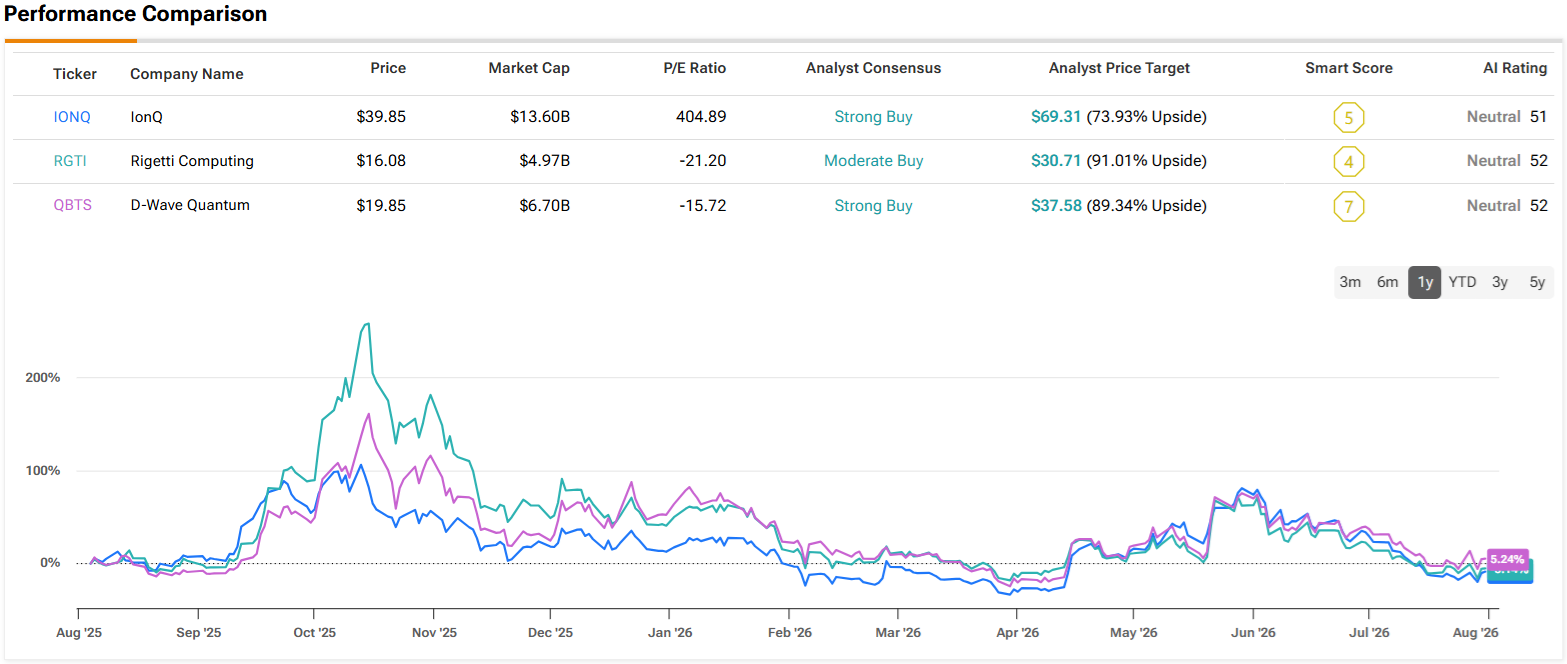
Quantum computing stocks are off to a strong start this week as investors position themselves ahead of their upcoming earnings. IonQ (NYSE:IONQ) climbed 9% in Monday’s session before reporting results on August 5, while Rigetti Computing (NASDAQ:RGTI) gained 7% and D-Wave Quantum (NASDAQ:QBTS) added 10% ahead of their August 6 reports.
Summer Sale - Claim 70% Off TipRanks
Explore QBTX for 2X leverage on QBTSFew industries have tested investors’ patience this year quite like quantum computing. Quantum stocks entered 2026 with lofty expectations following last year’s impressive rally, only to surrender a meaningful portion of those gains as investors reassessed valuations, commercialization timelines, and the pace of technological progress. Optimism returned several times as encouraging technical achievements, government support, and new commercial partnerships reminded investors why the technology continues to command such interest. That backdrop makes this week’s earnings reports especially important, offering another opportunity for companies to demonstrate that execution continues to match long-term expectations.
Wedbush analyst Matt Bryson, who ranks among the top 1% of Wall Street analysts, believes investors should spend less time dissecting quarterly revenue figures and more time evaluating the strategic progress each company discusses during its earnings call. While all three reports will include financial updates, Bryson believes the bigger story revolves around technology milestones, customer adoption, and management’s confidence in their long-term roadmaps.
For IonQ, Bryson expects the recently completed SkyWater acquisition to dominate the discussion. Since the acquisition closed after the quarter ended, investors will not yet see its full financial contribution. Instead, Bryson expects management to explain how the combined business will operate and what the acquisition means for future growth.
Bryson believes SkyWater gives IonQ “a genuine structural advantage” through ownership of a Department of Defense-accredited semiconductor foundry, reducing the company’s dependence on outside manufacturing while strengthening its production capabilities. At the same time, the analyst believes management will probably reserve a more detailed discussion of the acquisition’s longer-term financial impact for its September Investor Day. Until then, Bryson argues that “RPO and bookings are cleaner reads on demand than any single quarter of revenue recognition,” making those metrics more valuable than headline revenue. He will also be watching for any updates on whether IonQ is making progress toward translating its high-fidelity technology into commercially meaningful logical qubits.
Bryson views Rigetti through a similar long-term lens, although his primary focus differs. The analyst believes fidelity, rather than simply adding more qubits, represents the most important milestone during 2026. Successfully transferring prototype performance into commercially available systems would provide what he describes as “the harder and more relevant proof point,” while also representing “the one most likely to re-rate the shares.”
Beyond the technology roadmap, Bryson likes the direction of Rigetti’s commercial business. The analyst says the company’s customer base is “broadening in the direction we care about,” citing expanding enterprise relationships, cloud availability, and recent system deployments. Bryson also believes Rigetti possesses “runway sufficient to fund the roadmap without a near-term raise,” allowing management to remain focused on execution rather than financing.
Bryson offers a similar message for D-Wave, encouraging investors not to place excessive weight on a single quarter’s revenue performance. Given the timing of large quantum system sales, quarterly revenue can fluctuate considerably without changing the company’s long-term outlook. Bryson therefore believes investors should “treat a light 2Q as a timing outcome rather than a demand signal,” while paying much closer attention to bookings and pipeline commentary.
Bryson’s outlook for D-Wave remains constructive, arguing that the company’s commercial progress represents “the strongest evidence in the group of the transition from research contracts toward production customers.” Alongside commercial traction, the analyst will also monitor updates surrounding the company’s gate-model quantum computing roadmap and whether operating expenses continue tracking in line with expected revenue growth.
Looking beyond this week’s earnings, Bryson assigns Outperform (i.e., Buy) ratings to IonQ, Rigetti, and D-Wave. His price targets stand at $75 for IonQ and $40 for both Rigetti and D-Wave, implying upside potential of 88%, 147%, and 100%, respectively. (To watch Bryson’s track record, click here)
Disclaimer: The opinions expressed in this article are solely those of the featured analyst. The content is intended to be used for informational purposes only. It is very important to do your own analysis before making any investment.