


NIO (NIO) reported strong deliveries for Q2, and the numbers suggest the company’s improving margins may not be a one-off. After three years of heavy losses and capital-intensive expansion, the Chinese electric vehicle (EV) maker is beginning to look like a more financially disciplined business.
Summer Sale - Claim 70% Off TipRanks
- Unlock powerful investing tools with TipRanks Premium to make smarter, more confident investment decisions
- Subscribe to TipRanks Smart Investor Newsletter, and discover new investing opportunities with data-backed stock picks
NIO’s first-ever profitable quarter in December 2025 was followed by another quarter with positive adjusted operating earnings in Q1 2026, reported in May. Back-to-back profitable quarters and improving operating metrics support the view that NIO is moving beyond its speculative phase. Much of that progress traces back to management’s successful cost optimizations and scaled operations.
The second-quarter deliveries data supports a Buy rating on the beaten-down growth stock. If NIO’s September Q2 earnings report confirms what deliveries suggest, the stock could have further room to recover. A valuation recovery could positively reward patient investors going forward.
Strong Deliveries Support Steady Margins
The strong Q2 deliveries support steady margins and my Buy rating. In Q2 2026, NIO delivered 107,658 vehicles, up 49.4% year-over-year. Yet upon the announcement, NIO stock didn’t flinch. Total deliveries for the quarter slightly missed management’s target for between 110,000 and 115,000 vehicles.
NIO’s quarterly deliveries have substantially recovered from a Q1 2026 seasonal dip. With that recovery, the EV maker’s operating leverage, which led to its first adjusted operating profit in December 2025, appears here to stay, and gross margins may hold steady above 16% going forward, despite component-cost inflation and some margin dilution from the mass-market ONVO brand’s offerings.
The bull case on NIO stock rests on the evident operational leverage unlocked by NIO’s proprietary battery-swapping network, the diversification of its product portfolio into mass-market ONVO and Firefly line-ups, and international market penetration that may sidestep growing competition within China. NIO may report its third consecutive quarter of positive non-GAAP operating earnings in September and be on a path to positive free cash flow generation during the second half of 2026.
Bears May Focus on Competition and Tariffs
While optimism about NIO’s upcoming Q2 prevails, bearish investors may understandably focus on the hyper-competition within the Chinese domestic EV market. Automakers have been locked in a price war, prompting regulators to step in to check the unhealthy price competition. Bears may also point to ongoing tariff barriers in Western markets and to the recent Q2 2026 delivery numbers, which slightly missed the lower end of management’s guidance.
Even so, weighing these dynamics against NIO’s broader turnaround, a Buy rating still holds. Despite the minor guidance miss, the company has moved past its most capital-intensive, cash-flow-munching phase. Its heavy spending on infrastructure is starting to pay off, shifting from a cost center to a source of profit that could soon turn cash flow positive.
NIO’s Fortified Moats and Improving Fundamentals
NIO’s business model relies on a unique technological moat: its Battery-as-a-Service (BaaS) operation. This architecture was historically a huge drain on cash flow. Now, it has become a high barrier to entry for competitors and a strong moat generator. It allows NIO to decouple upfront vehicle purchase prices from the cost of pricey battery packs.
BaaS also lowers the cost barrier to premium vehicles and sustains long-term revenue streams through recurring subscriptions. The BaaS operation is carried out via an expanded network of over 3,900 battery-swap stations.
NIO’s Operational Brands
Operationally, the company’s core brand, NIO, has consolidated its dominance in the premium tier, that is, vehicles priced above 400,000 RMB. Successive new launches under this brand lead the segment market share. A key growth driver for the remainder of 2026 is the company’s ongoing product ramp of two sub-brands, ONVO and Firefly.
The ONVO brand addresses the mass-market segment of 200,000 RMB to 300,000 RMB, directly targeting volume metrics in which NIO previously had no presence until September 2024. Simultaneously, the Firefly brand establishes a foothold in the compact-vehicle segment.
The Q2 2026 volume contribution demonstrates the early viability of this multi-brand approach. ONVO deliveries have surged with new launches and more than doubled sequentially during the past quarter. Out of the 40,597 vehicles delivered in June 2026 alone, the core NIO brand accounted for 21,908 units, while the mass market ONVO brand contributed 11,743 units and Firefly chipped in strongly with 6,946 units.
This three-tier product structure allows NIO to capture multi-tier demographics while using the same underlying battery-swapping infrastructure. This effectively accelerates utilization rates of its legacy asset base, reducing per-unit costs and expanding margins.
Operational Leverage, Sustained Margin Expansion
A respectable 49.4% year-over-year growth in Q2 2026 deliveries supports sustained structural margin expansion. An inflection point was reached in Q4 2025, when manufacturing volumes hit a sweet spot that absorbed fixed costs and delivered NIO’s first profit. With fixed factory overhead, tooling depreciation, and R&D expenditures remaining relatively static, incremental volume increases directly translate into lower per-unit manufacturing costs.
NIO achieved a vehicle gross margin of 18.8% in Q1 2026, up significantly from 10.2% in the prior year period. However, I’d expect margins to compress sequentially in Q2, as lower-margin ONVO deliveries rose to 27% of the total mix, up from 16% in Q1, while premium-branded NIO deliveries fell to 57% of the total, down from 70%.
Although management had targeted 110,000 to 115,000 vehicles for the quarter, the realized 107,658 units should still provide sufficient scale to protect vehicle margins within the full-year target range of 17% to 18%.
Mix optimization within the core NIO brand helps offset the lower margin profile of mass-market platforms like ONVO. The premium NIO ES9 reached 10,000 cumulative deliveries within its first 30 days of launch, setting new segment records and establishing a high-margin anchor. NIO’s premium models generate above-average vehicle gross margins.
This provides a financial cushion for the company. It can absorb the lower initial margins of the ONVO and Firefly ramps. That cushion protects the consolidated gross margin needed to sustain non-GAAP net profitability in the second half of 2026.
NIO’s Valuation
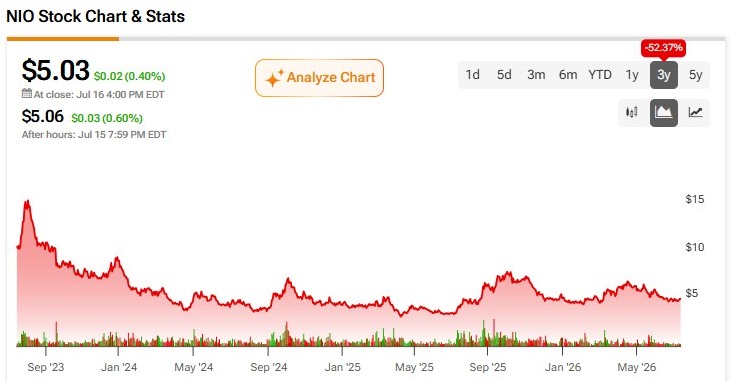
Evaluating NIO requires moving past historical trailing metrics and focusing on forward enterprise value-to-sales (EV/Sales) and EV/EBITDA multiples, given the company’s recent inflection toward positive non-GAAP operating profits. At recent prices around $5 a share, NIO stock trades at an attractive forward EV/Sales multiple of approximately 0.65x.
This represents a steep discount relative to its five-year historical average of 2.5x and stands significantly below a sector median of 1.2x. NIO’s low valuation multiples seem to ignore its superior near-term volume growth trajectory and its positive non-GAAP operating earnings visibility.
Free cash flow modeling suggests that if vehicle margins remain within a conservative 17%–18% range through the second half of 2026, the company may consistently generate positive free cash flow from operations.
Notable Risks
Despite NIO’s operational progress, several structural headwinds keep the bears somewhat agitated. The primary threat to my bullish opinion stems from the intense price competition characterizing the domestic Chinese automotive market. Competitors in some automotive alliances possess vast vertical integration advantages, enabling aggressive pricing actions that could compress NIO’s newly won margin gains.
The fact that Q2 2026 deliveries fell short of management’s 110,000 floor indicates competitive headwinds or supply chain bottlenecks for the newly launched ES9 and ONVO models remain active risks.
Further, raw material volatility could exert cost pressure, testing the resilience of the lower-priced ONVO platform. A tight global memory chip market raises overall production costs and may chip into margins.
Geopolitical dynamics represent another notable risk. Regulatory actions in the United States and expanded tariff structures within the European Union restrict NIO’s total addressable market expansion. By limiting export volumes into Western jurisdictions, NIO is forced to rely heavily on emerging markets and domestic demand, capping its top-line growth potential.
Finally, NIO’s battery swap network requires recurring maintenance capital expenditure, resulting in a higher baseline capital intensity compared to asset-light competitors.
Is NIO Stock a Buy?
Wall Street consensus has turned bullish on NIO stock following a recent upgrade from Goldman Sachs analyst Tina Hou to Buy from Hold. NIO receives a “Moderate Buy” rating based on six analysts who provided 3 Buys, 2 Holds, and 1 Sell over the past three months. The average analyst price target of $6.42 implies 27.5% upside over the next 12 months.

The combination of deep value multiples, improving fundamentals, and Wall Street upgrades may help drive sentiment higher and propel the EV stock to a sustained price recovery during the second half of 2026.