


AI remains Wall Street’s biggest investment theme, although enthusiasm has become far more selective during recent months. Much of that scrutiny has centered on hyperscalers – tech giants that operate massive cloud computing platforms and are leading the industry’s AI infrastructure buildout. Rather than celebrating every new AI announcement, investors are asking whether the hundreds of billions of dollars these companies are committing to data centers, chips, and related infrastructure will ultimately generate returns that justify the cost.
Summer Sale - Claim 70% Off TipRanks
Double your IBM exposure with Tradr's IBXThe concern is understandable. Building AI capacity requires unprecedented investment today, while many of the financial benefits will take years to materialize. As a result, quarterly earnings are no longer judged solely by revenue and profit growth. Investors are paying close attention to capital spending, free cash flow, and management’s ability to demonstrate that those AI investments will translate into sustainable earnings growth.
Morgan Stanley Chief U.S. Equity Strategist Mike Wilson believes those concerns have created an attractive opportunity rather than a reason to stay on the sidelines.
“Hyperscalers combine attractive relative value – their forward multiple is in just the third percentile back to 2023 – with meaningful optionality: resilient core businesses, upside from leadership in the AI application layer and underappreciated scope to reduce opex if needed. As both AI enablers and adopters, they offer a compelling multi-month risk/ reward… The Hyperscalers have outperformed Semis over the last 4 weeks, and we believe that will continue over the next several months,” Wilson opined.
Against this backdrop, Morgan Stanley analysts have taken a deep dive into Microsoft (NASDAQ:MSFT) and International Business Machines (NASDAQ:IBM), two of the leading names in the industry, and picked out the better hyperscaler stock to buy right now. Let’s take a closer look at which company they believe offers the more compelling opportunity.
Microsoft
Microsoft hardly needs an introduction. With a market capitalization of $3.6 trillion, it ranks among the world’s most valuable companies and generated $331.8 billion in revenue during fiscal 2026. While the company built its empire on software, today’s investment story revolves around Azure, AI infrastructure, enterprise AI applications, and the expanding Microsoft Cloud ecosystem, which has become one of the fastest-growing and most profitable businesses in technology.
Microsoft established an early lead in generative AI by investing $1 billion in OpenAI in 2019, with its total commitment eventually growing to about $13 billion. The partnership has since evolved into a more flexible arrangement. OpenAI can now work with multiple cloud providers, while Microsoft retains significant commercial rights and continues to receive 20% of OpenAI’s revenue under the revised commercial agreement, subject to an overall cap of roughly $38 billion. Meanwhile, Microsoft has broadened its AI strategy by developing its own AI models and custom chips while embedding Copilot throughout its product portfolio.
Azure remains the centerpiece of that strategy. During fiscal fourth-quarter 2026, Microsoft’s Intelligent Cloud segment generated $39.3 billion in revenue, up 32% year over year, while Azure and other cloud services grew 43%. Management also guided for Azure and other cloud services to grow about 45% in constant currency during the following quarter, suggesting AI demand continues to outpace available computing capacity.
To support that demand, Microsoft continues investing aggressively in AI infrastructure. The company is expanding its global network of data centers and AI computing capacity, with future lease commitments for data centers climbing to $329.1 billion at the end of fiscal 2026. Those investments reflect management’s expectation that enterprise demand for AI workloads will remain strong for years to come.
The spending is already translating into stronger financial performance. Microsoft reported fiscal fourth-quarter revenue of $90 billion, up 18% year over year and well ahead of Wall Street’s expectations. Non-GAAP earnings came in at $4.74 per share, exceeding consensus estimates by $0.50, as accelerating Azure growth and rising adoption of AI services demonstrated that the company’s massive infrastructure investments are beginning to generate meaningful returns.
Morgan Stanley analyst Adam Wood believes Microsoft’s recent results provide tangible evidence that its AI investments are translating into sustainable long-term growth.
“Microsoft’s F4Q26 results move the key elements of our investment thesis from expectation to evidence… With F4Q capex in line with our estimate and no material increase in the underlying CY26 investment plan, investors can increasingly focus on the revenue and earnings generated by the build rather than the spending alone. We continue to see a path to sustainable high-teens revenue growth and greater than 20% earnings growth… Microsoft guided Azure to ~45% constant-currency growth in 1Q27 and reiterated that growth in F1H27 should accelerate from F2H26… This supports our thesis that Azure can sustain stronger topline growth for longer,” Wood noted.
To this end, Wood sets an Overweight (i.e., Buy) rating on MSFT, along with a $600 price target that indicates room for a one-year gain of 23% for the stock. (To watch Wood’s track record, click here)
The Street generally is bullish on Microsoft. The stock’s Strong Buy consensus rating is based on 36 recent recommendations, with a lopsided split of 35 Buys to 1 Hold. The stock is currently trading for $487.46, and its $560.52 average target price implies a one-year upside potential of 15%. (See MSFT stock forecast)

IBM
Next up is IBM, one of the world’s leading enterprise tech companies. With a market cap of about $222 billion, IBM generated $67.5 billion in revenue during fiscal 2025. While the company is best known for its enterprise software and consulting businesses, its investment story today revolves around hybrid cloud, AI, and automation. Backed by its Red Hat acquisition and the watsonx AI platform, IBM is helping businesses modernize legacy IT systems and integrate generative AI into their operations.
IBM generates revenue through three core segments: Software, Consulting, and Infrastructure. Its Software business is the company’s primary growth engine, offering hybrid cloud platforms, AI tools, automation software, data management, and cybersecurity solutions. Together, these products help large enterprises modernize their IT environments, improve productivity, and deploy AI across their organizations.
The consulting side provides professional services, including such operations as business model transformations, cloud architecture designs, and even custom AI model integration. And under infrastructure, IBM provides the large-scale physical hardware and tech stack that global enterprises need to support data center, AI, and cloud operations.
Last month, however, IBM saw its share price drop sharply – in fact, the 24% share price drop on July 14 marked its worst single day since the 1987 market crash. The collapse came when the company announced preliminary results for 2Q26 – pre-release revenue figures were significantly lower than expected, and management said customers redirected capital spending toward AI infrastructure – including servers, storage, and memory – at the expense of software and other IT projects.
In the actual earnings release for 2Q26, made public on July 22, IBM noted $17.2 billion in total revenue. This figure was up a mere 1% year-over-year, and missed the forecast by $101.7 million. IBM’s revenue included $7.8 billion in software (up 5% y/y); $5.3 billion in consulting (flat y/y); and $3.8 billion in infrastructure (down 7% y/y). The company’s Financing segment contributed the remaining revenue and grew 12% year over year. IBM reported $2.93 in non-GAAP EPS, in line with the Street’s expectations.
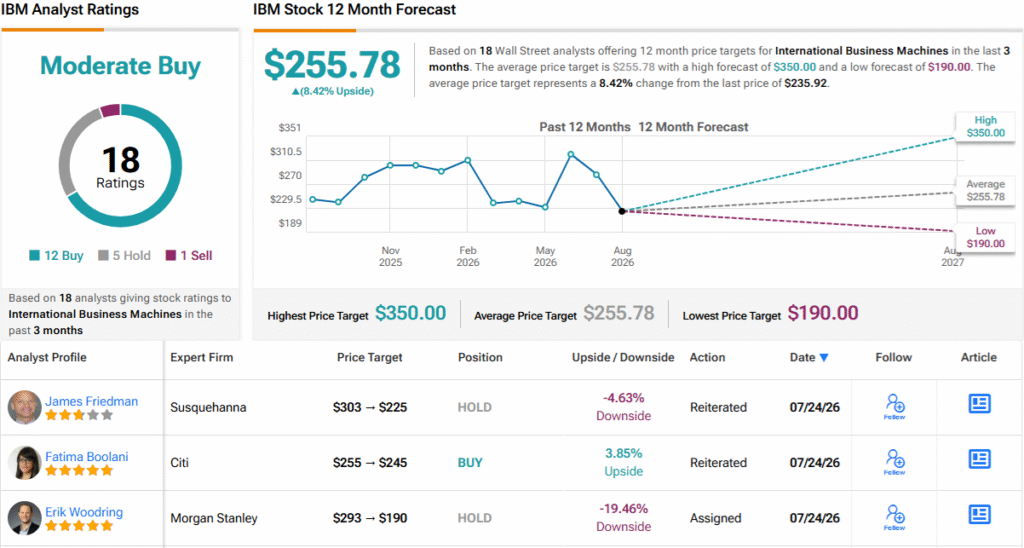
Morgan Stanley’s 5-star analyst Erik Woodring, who is rated by TipRanks among the top 2% of the Street’s experts, has taken notice of IBM and says the company’s expected second-half recovery is likely to be the key issue investors will be watching during the coming months.
“Management is banking on a 2H recovery – will it materialize? We believe this is the key debate that will influence Wall Street’s assumptions on earnings power, organic growth, and ultimately – valuation – over the next 6 months… The 2H recovery case is plausible, supported by early deal recapture and stronger productivity, but guidance leaves little room for error and requires a sharp Z rebound… We estimate the 2H “base case” guide embeds a meaningful Software and z17 recovery that requires sequential revenue dollar growth strength not seen in over 3 years, even as management acknowledges the capex deferral environment and below-normal pipeline yields are assumed to persist in this case,” Woodring stated.
Based on this, Woodring rates IBM shares as Equal-weight (i.e., neutral), and his price target of $190 suggests a 19% downside for the stock by this time next year. (To watch Woodring’s track record, click here.)
Overall, Wall Street is somewhat more bullish on this venerable business-tech company. IBM has earned a Moderate Buy consensus rating, based on 18 reviews that include 12 Buys, 5 Holds, and 1 Sell. The shares are currently trading at $235.92 and their $255.78 average price target indicates an 8% upside on the one-year horizon. (See IBM stock forecast)
With the facts laid out, it’s clear that the Morgan Stanley analysts prefer Microsoft as the better hyperscaler stock to buy in today’s environment.
Disclaimer: The opinions expressed in this article are solely those of the featured analysts. The content is intended to be used for informational purposes only. It is very important to do your own analysis before making any investment.