


Meta Platforms (META) spent much of 2026 struggling in the very area where it is now regaining momentum: artificial intelligence (AI). Basically, Meta turned its ‘AI problem’ into a catalyst.
After aggressively raising capex and seeing free cash flow plunge over the past several quarters, the Menlo Park, California-based Big Tech company left investors puzzled over the return on all that spending. In recent weeks, that answer has started to take shape with the launch of Muse and, more recently, the Meta Enterprise Platform. That has helped turn the stock’s momentum around and reignited the discussion around new revenue streams beyond advertising.
The problem is that META has already staged a massive rebound, at one point rising nearly 50% from its lows. My thesis is that the bull case still holds, but now it needs to show up in earnings. So I maintain a Buy rating, though with a thinner margin of safety.
Meta’s 2026 Volatility Was Never about the Core Business
META has had a remarkably volatile ride higher in 2026. Shares briefly touched the $520 level over the past 52 weeks before reaching $779 on September 24 — a nearly 50% trough-to-peak rally. At $738.79 today, the stock remains roughly 42.08% above its lows, but about 5.16% below its recent high.
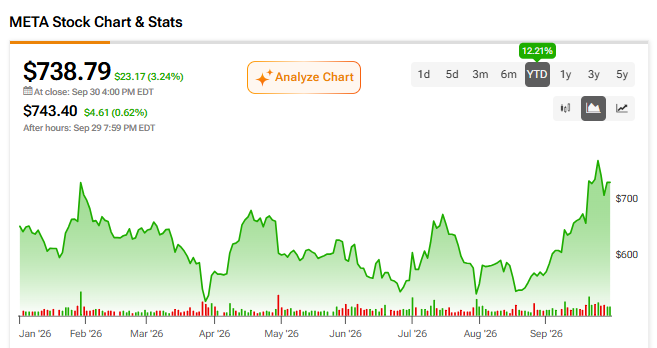
Importantly, this volatility was not driven by deterioration in Meta’s advertising business. In Q1, for example, revenue grew 33% year-over-year. Still, the stock fell about 10% after Meta then raised its capex forecast to $125–$145 billion, from the previous $115–$135 billion forecast.
Concerns intensified after Meta reported Q2 results in late July. Revenue still grew 28% year-over-year, but costs jumped 55%. Operating margin fell from 43% to 31%, while free cash flow plunged to just $784 million. At the same time, the lower end of Meta’s capex guidance rose again to $130 billion.

The problem was that investors still couldn’t clearly see the payoff from these ultra-aggressive investments. In fact, Meta had the highest trailing capex-to-revenue ratio among Big Tech at 0.39 in early 2026. That compared with 0.34 for Microsoft (MSFT) and 0.29 for Alphabet (GOOGL).
What Changed Meta’s Momentum?
Muse changed Meta’s momentum. The turning point for META stock came when the market finally got something it had been missing all year: a visible link between the billions spent on AI and a new product that could actually be monetized.
Launched on September 8, Meta Muse is a personal AI agent. In its first 12 days, it recorded 2.8 million downloads across the U.S. and Canada. It also surpassed OpenAI’s ChatGPT in the app stores and started showing real use cases in shopping, travel bookings, emails, and transactions. META rose more than 20% in roughly two weeks after Muse’s launch.
More importantly, Muse changed the narrative around Meta’s aggressive AI infrastructure spending. Earlier, investors saw roughly $140 billion in capex with no clear answer on the payoff. Now, Muse gives them something tangible to connect with that spending. While it’s only one piece of the puzzle, that alone makes a big psychological difference for the stock.
With Muse, the market also started thinking about monetization through subscriptions, commerce take rates, payments, and eventually advertising. TD Cowen, for example, modeled Muse reaching 1 billion daily active users by 2031, with roughly 67.8 million paid users and $27 billion in annual revenue. This is only a sell-side scenario, but it shows how quickly the discussion has shifted from “where is the revenue?” to “how much revenue can it generate?”
Meta Is Also Building a Bridge to Enterprise
There’s no shortage of news around Meta in the AI space. On September 28, the company announced the Meta Enterprise Platform. It also hired Chirantan “CJ” Desai, formerly CEO of MongoDB (MDB), to lead it.
The platform is expected to bring together Muse, Business Agents, coding tools, and other enterprise-focused AI products. This is significant because it addresses a weakness the market saw in Meta compared with Microsoft, Amazon (AMZN), and Alphabet. Much of the bear case was based on the idea that Meta lacked a clear path to monetize AI outside advertising.
This move into enterprise AI now opens at least three paths for Meta. The first is consumer AI through Muse, with potential revenue from commerce and subscriptions. The second is the core Family of Apps, through better ads and higher engagement. The third is the Enterprise Platform, with business AI, agents, and APIs.

Muse and enterprise AI are still opportunities, and not yet guaranteed profits. Still, the monetization roadmap is much clearer now. That gives Meta more upside optionality than the thesis had just a month ago.
META Stock May Have Run ahead of Earnings
Even with the flood of seemingly great news for Meta, the downside is that the market has likely already priced in much of it. The asymmetry that existed before is no longer as obvious.
Despite the roughly 50% rebound from the 52-week lows, earnings expectations have barely followed the stock higher. The current consensus calls for earnings per share (EPS) of $30.92 in 2026 and $34.84 in 2027.
Three months ago, those estimates stood at roughly $31.77 and $36.32, respectively. Six months ago, they were about $30.32 and $36.06. In other words, the recent rally has been driven much more by multiple expansion and renewed optimism around Meta’s AI opportunities than by upward earnings revisions.
Meta now trades at around 23.1x forward non-GAAP earnings, about 4.9% above its five-year average. That hardly looks stretched for a company still expected to grow EPS at a double-digit pace over the next several years. However, valuation is no longer giving investors much of a tailwind. That means the next leg higher will increasingly depend on earnings revisions catching up with the narrative.
Is META a Buy, According to Wall Street Analysts?
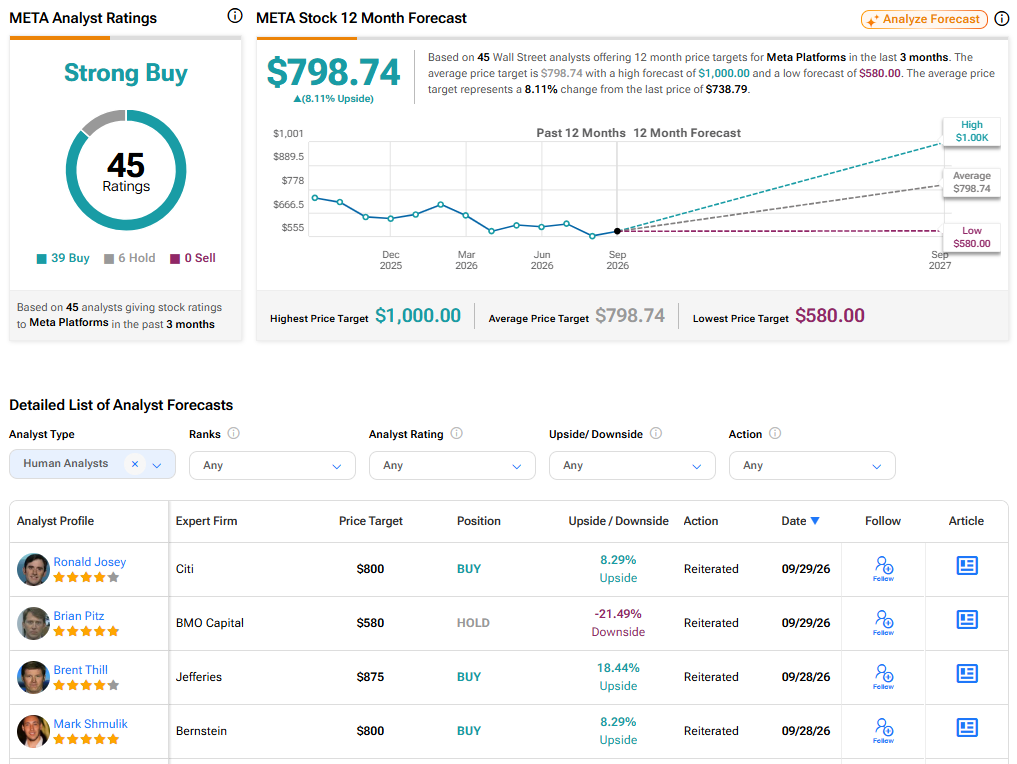
The consensus among Wall Street analysts on META is very bullish, with an overall Strong Buy rating. Of the 45 ratings issued over the past three months, 39 are Buy and only six are Hold. The average Meta price target is $798.74, implying about 8.11% upside from current levels.
META’s Bull Case Now Needs Earnings to Deliver
Some of the skepticism around Meta’s aggressive AI infrastructure spending has been addressed by the launch of Muse and the Enterprise Platform. That is clearly positive and, in my view, helps justify some of the recent multiple re-rating.
From here, however, Meta needs to show that these investments can translate into earnings growth above current expectations. That is what would support further upside in the stock.
I believe that is entirely plausible given Meta’s massive distribution, the potential for AI to further improve its already powerful advertising engine, and the optionality from new revenue streams. That is enough to support a Buy rating on Meta, even though the stock is clearly less asymmetric after its massive run from the lows.