South Korean retail investors are taking heavy losses after leveraged bets on Samsung Electronics (SSNLF) and SK Hynix (SKHY) unraveled, showing how quickly a crowded AI trade can turn when borrowed money and daily-reset funds are involved.
Summer Sale - Claim 70% Off TipRanks
200% short exposure to AMZN with AMZOThe damage has been most severe in single-stock leveraged ETFs tied to the country’s two largest chipmakers. The KODEX SK Hynix Single Stock Leverage ETF, which aims to deliver twice the stock’s daily move, has fallen about 70% from its June high and roughly 50% since its May 27 debut, according to LSEG data.
Retail investors drove much of the boom. Since the products launched, they have bought a net ₩14 trillion, or about $9.4 billion, of single-stock leveraged ETFs. Foreign investors bought about ₩2 trillion, according to KB Financial Group.
That gap means local individuals are carrying most of the losses.
Leverage Turns a Pullback into a Rout
The selloff followed a sharp reversal in Samsung Electronics and SK Hynix, which had climbed with the global rush into AI and memory-chip stocks. SK Hynix suffered a record one-day drop last week, adding to losses for investors who had doubled down through leveraged products.
These funds are built to amplify daily returns, not to track twice the stock’s long-term performance. During a volatile decline, daily resets and compounding can erode value faster than many investors expect.
The risk is spreading across the Korean market. Assets in the 25 largest leveraged Korea ETFs reached about 30% of Korea-focused fund assets by June, up from roughly 15% at the start of 2026, according to Oxford Economics.
South Korea’s central bank also warned that leveraged retail stock investing had climbed to a record, driven by margin loans and concentrated semiconductor positions. It said the buildup was unlikely to threaten the wider financial system, but could deepen market swings during a correction.
Regulators Move to Cool Speculation
South Korean regulators are now tightening access to single-stock leveraged ETFs. Investors will need to post at least 30 million won in cash to trade the products, up from an effective minimum of 3 million won.
The tenfold increase could cut demand for the funds and remove some of the retail buying that helped support Samsung and SK Hynix during the rally. Semiconductor and memory stocks are heavily held by both institutional and retail investors, leaving them vulnerable if AI spending expectations weaken.
Thomas J. Hayes of Great Hill Capital said the trade had become overcrowded and warned that a pullback in capital spending from major cloud companies could drive investors out of chip stocks as quickly as they piled in.
That makes upcoming earnings guidance from large U.S. hyperscalers a key test. Any sign that AI infrastructure spending is slowing could pressure expectations for memory-chip demand and add another round of selling to an already painful trade.
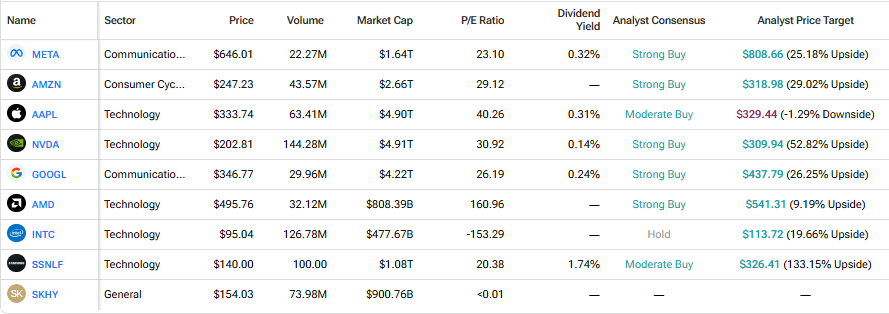
We used TipRanks’ Comparison Tool to line up SK Hynix and Samsung alongside U.S. hyperscalers to gain a broader view of memory chip demand and a more specific view of each stock.