


PayPal’s (PYPL) turnaround still needs more proof, even after its Q3 FY2026 report showed higher adjusted earnings per share (EPS) and an improved full-year outlook. PayPal Holdings operates a global digital-payments network spanning its PayPal and Venmo wallets, branded checkout, Braintree payment processing, credit products, and other merchant services. At the end of 2025, its network connected 440 million active accounts across roughly 200 markets.
There is progress. PayPal’s Q3 FY2026 revenue increased 2% year-over-year to $8.58 billion; transaction margin dollars rose 2% to $4 billion. Non-GAAP EPS climbed 8% to $1.45, and total payment volume (TPV) also advanced 6% to $487.1 billion.
Still, revenue fell short of Wall Street’s roughly $8.71 billion estimate, while the company’s most important branded checkout business remained sluggish. That tension keeps me neutral on PYPL with a Hold rating.

PayPal’s EPS Growth Doesn’t Tell the Whole Story
PayPal’s EPS growth doesn’t tell the whole story, especially when you look at its underlying profitability. Non-GAAP EPS rose 8% to $1.45, above the $1.31 consensus estimate, and management raised its full-year adjusted EPS forecast to about $5.60 from roughly $5.38 previously, which is encouraging.
Yet looking above EPS makes the picture less convincing. Non-GAAP net income declined 3% year-over-year to $1.25 billion, while GAAP net income fell 14% to $1.07 billion. PayPal’s share count has also fallen sharply: shares outstanding were down 8.8% year-over-year as of early November. In other words, repurchases are helping per-share earnings grow faster than the underlying profit pool.

This does not make the EPS growth meaningless. Buybacks create value when shares are repurchased cheaply. Yet a lasting rerating probably requires revenue and transaction margins to accelerate as well. Freedom Capital Markets analyst Mikhail Paramonov made a similar point when he downgraded PYPL to Hold in early November, arguing that recent EPS growth reflected expense discipline and a lower share count rather than a clear acceleration in the core business.
Branded Checkout Remains the Missing Piece
Branded checkout remains the missing piece in PayPal’s turnaround, and it’s the main reason I’m reluctant to become bullish. Online branded checkout payment volume growth has remained around 1%–2% for four consecutive quarters, and management expects a similar pace through the fourth quarter.
Branded checkout has historically been one of PayPal’s more valuable businesses. The company itself acknowledges intense competition across digital wallets and payment methods, with consumers and merchants able to choose among bank products, card networks and competing payment technologies.
There are brighter spots. Braintree Total Payment Volume (TPV) grew about 10% in Q3 FY2026, while Venmo produced mid-teens volume growth. Management also expects financial services to contribute more than 20% of transaction margin dollars in 2026, with double-digit growth.
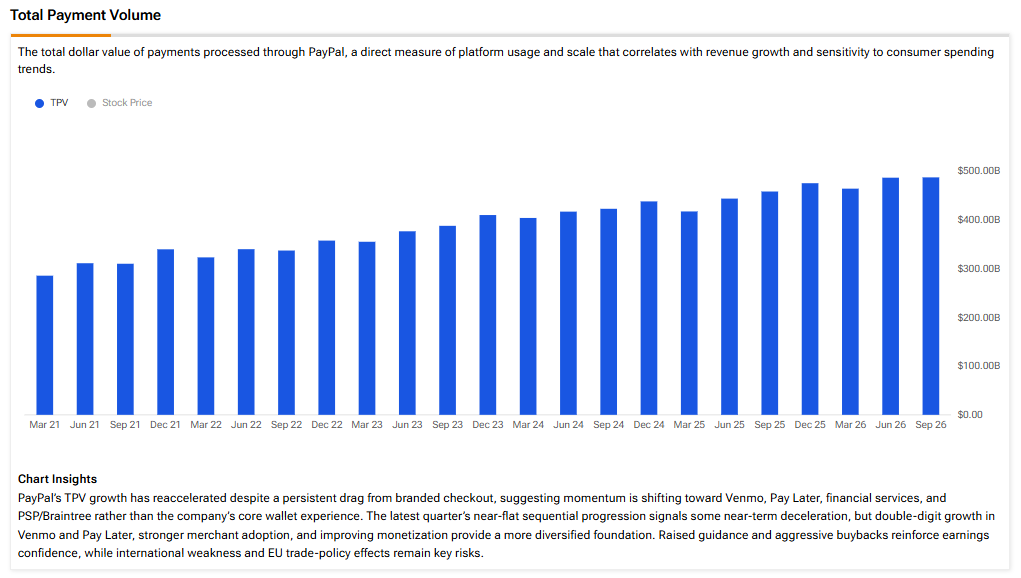
These businesses do not eliminate the need to stabilize PayPal-branded checkout. Until product updates begin taking share or meaningfully accelerating growth, I think investors should keep questioning whether the broader transformation is changing PayPal’s competitive position or merely improving efficiency around a slow-growing core.
PayPal’s Cash Flow and Buybacks Provide Support
PayPal’s cash flow and buybacks provide some reassurance, making a bearish rating difficult to justify. The company generated $1.43 billion in free cash flow (FCF) and $2.05 billion in adjusted FCF in Q3 FY2026. Management now expects at least $6.5 billion in adjusted FCF for the Fiscal year 2026.
PayPal also repurchased roughly $1.5 billion of stock during the quarter and $6 billion over the trailing 12 months and continued returning capital to shareholders, with its board declaring a quarterly dividend of $0.14 per share.
The caveat here is that Q3 FY 2026 FCF fell 17% year-over-year from $1.72 billion. Even so, PayPal’s ability to generate several billion dollars of annual cash flow gives management considerable room to reduce the share count and invest in the turnaround. This is what keeps PayPal out of Sell territory for me.
PayPal’s Valuation
At its current price, PayPal trades at roughly 10.6x forward price-to-earnings (P/E) and 11x trailing earnings. This is a substantial compression from earlier years. PayPal traded at roughly 18.2x forward P/E at the end of FY 2024, and its five-year average forward P/E is 16x. The current multiple is also far below Visa’s (V) forward P/E of about 28.1x and Mastercard’s (MA) 32.7x.
The discount makes PYPL look inexpensive, but I would not call it obviously mispriced. Visa and Mastercard have different business models and stronger recent growth profiles, while PayPal still needs to demonstrate that branded checkout can reaccelerate. The low multiple already reflects this, which supports a Hold rather than either extreme.
What Could Change My Hold Thesis?
A sustained rebound in branded checkout could change my Hold thesis and push me toward a Buy rating, particularly if PayPal pairs it with stronger transaction-margin growth. Faster monetization of Venmo and financial services would strengthen that case. Management’s plan to deliver at least $1.5 billion of gross run-rate cost savings over the next two to three years could provide another lever if those savings translate into durable earnings rather than being fully reinvested.
The downside case is equally clear. Continued market-share pressure in checkout, weaker consumer spending, or further deterioration in FCF would make the low valuation look less like an opportunity and more like a value trap.
Wall Street’s Outlook for PYPL
Wall Street remains cautious on PYPL, with a Hold consensus rating based on three Buys, 22 Holds, and four Sells over the past three months. At $57.60, the average analyst price target implies about 2.77% downside from the last price of $59.24.

Recent analyst revisions reflect similar hesitation about PayPal’s turnaround. Freedom Capital analyst Mikhail Paramonov downgraded the stock from Buy to Hold and cut his price target from $72 to $63 as the company’s core business continues to struggle to stabilize. TD Cowen analyst Bryan Bergin raised his target from $59 to $60 but kept a Hold rating, noting progress in Venmo and PayPal’s financial services business.
Conclusion
Both analysts see room for improvement, but neither sees enough evidence to justify a Buy rating, and I share their caution. PayPal’s attractive valuation and cash generation offer some reassurance, but until branded checkout improves meaningfully, I believe a Hold remains the more reasonable stance.