


Quantum computing, once a dream, is truly here, and the implications are starting to come into focus. There are two: the sheer size of the addressable market for quantum computing, and the enormous potential improvements in computing performance.
On the first, McKinsey’s estimates suggest quantum computing is beginning to move beyond its early commercial stage. Industry revenue climbed from roughly $750 million in 2024 to $1 billion in 2025, representing growth of more than 30%, and could reach about $2 billion in 2026. The longer-term numbers are far larger: McKinsey sees quantum computing developing into a $700 billion-plus market opportunity between 2035 and 2040, putting its potential scale in the same neighborhood as today’s generative AI market.
Top Roth analyst Suji Desilva, who ranks among the top 1% of Wall Street analysts, has been examining where the quantum computing market stands today and, more importantly, where it goes from here. He sees the industry progressing through three distinct phases, with the second now getting underway.
“We expect quantum computing to be realized in three phases. Phase I will focus on establishing quantum utility and this phase has largely covered the last few years. Today, we are entering Phase II which will cover the next few years (2027 to 2030) and see the quantum industry establish quantum advantage. As quantum advantage advances, we expect a move toward broad advantage during which the industry will see consistent quantum advantage performance across key workloads… As we look ahead to Phase III starting around 2030 and beyond, we expect the industry to establish fault-tolerant quantum computing (FTQC) platforms. FTQC ensures reliable quantum computations by automatically correcting errors,” Desilva explained.
Against this backdrop, Wall Street analysts, including Desilva, are turning their attention to quantum computing stocks they believe could have substantial upside in the months and years ahead. And their focus isn’t limited to the sector’s established names. They’re also looking closely at a newer group of quantum companies that have only recently reached the public markets through SPAC deals, giving investors another way to participate in the industry’s long-term growth potential.
We’ve dipped into the TipRanks database to take a closer look at two of these new quantum computing stocks. Here are the details, and the analyst comments.
IQM Quantum Computers (IQMX)
The first stock we’ll look at here is IQM Quantum Computers, a Finnish-based quantum company that has become one of Europe’s leaders in the field. IQM is known for its line of full-stack superconducting quantum computers, designed to support high-performance computing applications, top-level research projects, and the needs of large-scale enterprises. IQM offers quantum machines that can be established on-site or accessed via the cloud – the choice is up to the customer.
IQM has several different models of quantum computer available for commercial and private use. The smallest of these, the Spark, is its most affordable unit, and is designed to be installed on-site. Spark is a 5-qubit system, popular with universities and research centers, where it is frequently used for teaching and educational purposes.
Move up a step and you come to IQM’s more advanced Radiance system, the company’s most powerful on-site quantum computer. Radiance can be configured with 20, 54, or 150 qubits, and is making a splash in high-performance computing centers, as well as with quantum computing pathfinders, who are breaking new ground in what computing can do in the real world.
IQM is also working on the cutting edge of quantum computing. Its Halocene quantum computer is a 150-qubit system that has been designed to facilitate research in quantum error correction (QEC), and to speed up the quantum industry’s move toward fault-tolerant computing.
In addition to these on-site systems, IQM also offers customers access to Resonance, its quantum computing cloud service. This cloud system makes 20- and 54-qubit quantum computing available, includes built-in error handling, and offers users a wide range of capabilities.
This is a serious set of services for any quantum computing company, and it forms the base of IQM’s business. And on that base, the company went public on the NASDAQ this past July 2. The shares, under the IQMX ticker, were taken public through a SPAC merger with Real Asset Acquisition Corp. Following the SPAC transaction, IQM reported a pro forma cash position of €337 million; today, the company boasts a market cap of ~$2 billion.
Shares in IQMX are down almost 18% since entering the public markets, after several weeks of volatile trading. At least one reason for that decline is the company’s cash burn. In the six months ending on June 30 this year, IQM reported an operating loss of 60.5 million Euros, equivalent to one-fifth of the July 2 cash balance, stated as 309.4 million Euros.
Total revenue for the first half of this year came to 8.9 million Euros. Looking forward, however, the company’s order backlog is solid and growing – it stood at 69.12 million Euros on June 30, and at $102.1 million on August 3.
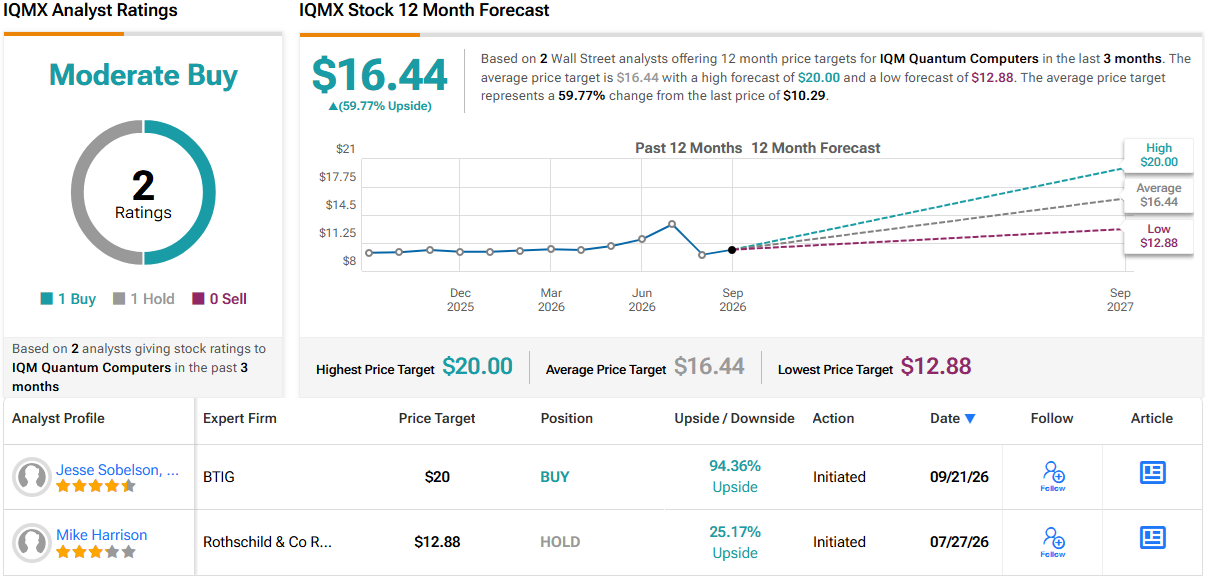
Taken together, those factors have caught the eye of BTIG analyst Jesse Sobelson, who sees plenty to like about IQM as the company moves into the next stage of its development.
“Large-scale fault-tolerant quantum computing remains hard for everyone in this industry, no exceptions. But we believe IQM’s installed-system model, manufacturing investments, and deep relationships with research and supercomputing institutions give it a genuinely differentiated foundation heading into its next phase. Alternative-modality players like Quantinuum and Infleqtion may lead today on demonstrated error correction and logical qubits, but IQM’s natively fast architecture, vertically integrated manufacturing, and unmatched deployment track record make its technology squarely competitive with superconducting heavyweights GOOG and IBM. Add a valuation sitting at less than half of Rigetti’s, and we think the market simply hasn’t caught up to what IQM has already built,” Sobelson opined.
Quantifying his stance on IQMX, Sobelson assigns the stock a Buy rating and a $20 price target that suggests a robust one-year upside potential of 94%. (To watch Sobelson’s track record, click here)
Right now, there are only 2 recent analyst reviews on file for IQMX, and they split into 1 Buy and 1 Hold for a Moderate Buy consensus rating. The shares are priced at $10.29 and their $16.44 average target price implies a 12-month gain of ~60%. (See IQMX stock forecast)
Pasqal (PSQL)
The next quantum stock we’re looking at here is the French company Pasqal, which has become a global leader in the quantum sector since its founding in 2019. The company is a builder and operator of neutral-atom quantum computers, which are used in industrial, scientific, and governmental applications. Like IQM above, Pasqal makes its quantum systems available both on-site and on the cloud.
The company’s neutral-atom technology uses lasers as ‘optical tweezers’ to grab onto individual rubidium atoms. At that level of scale, all atoms of a single element are inherently identical to one another, making for a uniform foundation for the quantum computer’s use of a dual analog-digital processing system. Pasqal’s quantum computers operate at room temperature, obviating any need for expensive, energy-intensive cryogenic cooling units. The company leverages this to achieve an efficient and scalable architecture.
Pasqal’s cloud services form an important part of the company’s products. They’re offered on the popular as-a-service model, as Quantum Computing as a Service, or QCaaS. Pasqal has an international footprint, and this past August the company entered into an agreement with the King Abdulaziz City for Science and Technology, in Saudi Arabia, to develop and promote advanced quantum technology, and to improve quantum cryptography readiness in Saudi Arabia. It’s an ambitious program that will deeply embed Pasqal within Saudi Arabia.
At the end of August, Pasqal entered the US stock markets. Like IQM above, Pasqal used a SPAC transaction to do this, combining with Bleichroeder Acquisition Corp. II (BBCQ) in a transaction that completed with Pasqal having some $360 million in available cash – and saw the PSQL ticker start trading on August 28.
After the SPAC, PSQL was valued at some $2 billion – but the company has a market cap of $1.59 billion now. The sharp drop in value came after investors noted that the company’s revenue last year was only in the low tens of millions, and would not support that high valuation. A combination of pullbacks and post-SPAC profit-taking drove the share price down.
Despite the drop in share price, Roth analyst Suji Desilva remains sanguine about the stock’s prospects, arguing that Pasqal’s existing technology, commercial deployments, and revenue pipeline give the company a strong foundation for the next stage of the quantum computing market.
“With a strong base of technology built on Nobel Prize-winning research and France’s sovereign national commitment to quantum innovation, PSQL has already deployed neutral atom processors and systems globally. We believe PSQL’s platform of competitive quantum computing technology can continue to gain share in the growing quantum market as the company advances its quantum offering to target increasingly complex problems… We project strong CY26/CY27 revenue growth of +50-100% y/y, reflecting strong backlog coverage and pipeline opportunity. Our growth forecast assumes that the number of production systems will grow four-fold by CY28. We have confidence in our near-term forecast given the €66M backlog as of March 2026,” Desilva opined.
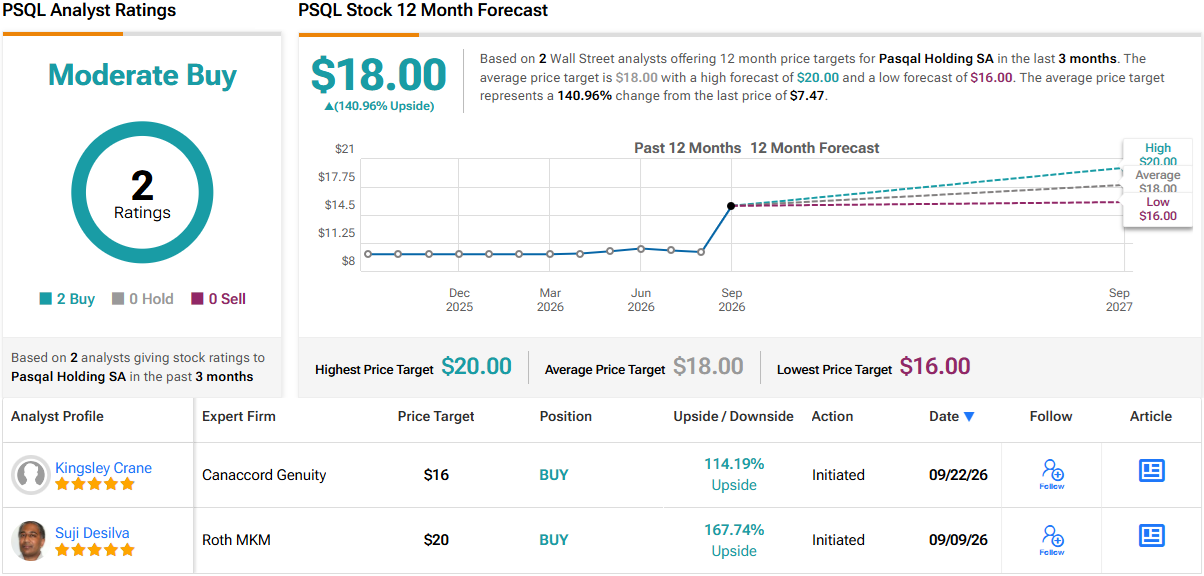
Desilva goes on to rate PSQL shares as a Buy. His price target, which he sets at $20, implies that this newly public stock has a powerful 168% upside potential for the year ahead. (To watch Desilva’s track record, click here)
Both recent analyst reviews here are positive, making the Moderate Buy consensus rating unanimous. The shares combine a $7.47 current trading price with an $18 average target price, giving Pasqal’s shares a potential gain of 141% by this time next year. (See PSQL stock forecast)
Disclaimer: The opinions expressed in this article are solely those of the featured analyst. The content is intended to be used for informational purposes only. It is very important to do your own analysis before making any investment.