


The record-breaking Q2 and fantastic Q3 guidance from Taiwan Semiconductor Manufacturing Company Limited (TSM) suggest that the artificial intelligence (AI) supercycle is accelerating. The semiconductor foundry, widely known as TSMC, is collecting a toll on almost every serious leading-edge chip program. Revenue, margins and advanced-node demand all moved higher together, while management’s next-quarter outlook suggested the pace is still quickening.
In the meantime, the stock appears attractively priced considering its earnings growth prospects and competitive advantages. That one-of-a-kind mix is why I remain bullish on TSM stock, even after its remarkable run.
Record Margins and HPC Domination
Record margins and high-performance computing (HPC) domination were the key highlights in TSMC’s Q2 report, in my view. Revenue hit $40.20 billion, the top of management’s guidance, rising 12% sequentially and 33.7% in USD terms from last year. In New Taiwan dollars, the increase was 36%.
Net income climbed 77.4% while earnings reached $4.31 per ADR, about $0.50 — or 13% — above the $3.81 Wall Street estimate. A NT$63.2 billion gain on TSMC’s Vanguard International Semiconductor (VIS) holding helped the bottom line. Regardless, the operating performance was exceptional.
The overall mix tells us where the chip industry is moving. HPC revenue jumped 20% from Q1 and represented 66% of company sales, up from 61%. Technologies at 7 nanometers and below supplied 77% of wafer revenue. In fact, 5nm contributed 33%, 3nm 30%, 7nm 11%, and the first meaningful shipments of 2nm added 3%. So the expensive, technically demanding end of the market is becoming TSMC’s core business, not just a small premium layer sitting on top as was the case earlier.

The better product mix, higher utilization and lower costs pushed gross margin to a record 67.7%, just above the top end of TSMC’s 65.5%–67.5% guidance. Operating margin followed at a remarkable 60.3%. The overseas fabs are still a drag on profitability, but the rest of the business was strong enough to make that drag look fairly small. To me, that says quite a bit about TSMC’s pricing power and how much leverage sits in its manufacturing base.
Customers may design incredible chips, but those designs do not mean much without someone who can manufacture them at scale and deliver reliable, leading-edge yields.
Q3 Momentum Gets ASML Validation
In the meantime, TSMC’s Q3 momentum gets validation from ASML (ASML) in both TSMC’s guidance and the equipment sitting upstream. TSMC sees $44.6 billion to $45.8 billion of Q3 revenue. The $45.2 billion midpoint implies another 12% sequential rise and roughly 37% year-over-year growth. Gross margin should remain between 65% and 67%, with an operating margin of 56%–58%, despite the costly 2nm ramp.
TSMC also lifted expected 2026 revenue growth to slightly above 40% in USD and increased capital spending to $60 billion–$64 billion. Notably, that higher spending isn’t speculative. CFO Wendell Huang highlighted that the steep 2nm ramp should cut second-half gross margin by three to four percentage points. However, demand and efficiency gains are counterbalancing much of the pressure.
CEO C.C. Wei described AI demand as extremely robust and noted that agentic AI is increasing the need for central processing units (CPUs) as well as graphics processing units (GPUs) and custom accelerators. TSMC also added $100 billion to its Arizona plan, lifting the total commitment to $265 billion, while back-end packaging capacity remains in “shortage mode.”
ASML supplied more useful outside confirmation one day earlier. The lithography leader reported €9.33 billion in Q2 sales and €2.92 billion in net income. It raised its 2026 sales outlook to €43 billion to €45 billion. What I care about more here is that ASML plans to add 30% to its roughly 65-unit low-NA EUV capacity in 2027 and is studying another 30% increase for 2028. Those machines are essential to leading-edge production.
ASML’s plans do not prove TSMC’s individual order book, but they support the same conclusion that advanced-node demand is being planned in years, not quarters.
The Selloff Creates an Opening
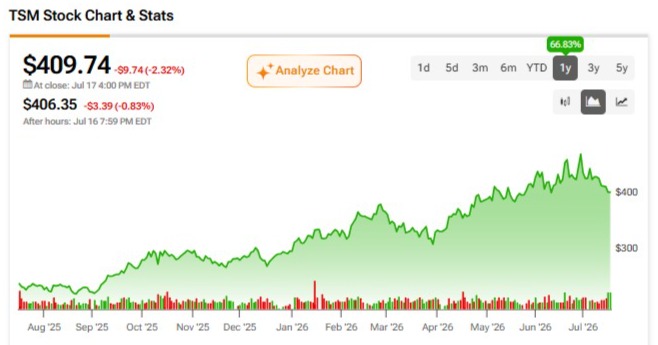
TSMC’s post-earnings sell-off creates an opening, in my view. TSM is now trading at $410 on Thursday’s open, down almost 2.5%. Some profit-taking is hardly shocking after a gain of about 67% over the past year. Expectations were high, and the market is selling the news. Still, that forms an opportunity.

At today’s share price, the valuation still looks reasonable despite the growth. The current consensus 2026 earnings per share (EPS) estimate is roughly $17.09. That puts TSM at about 24x earnings. Notably, Wall Street’s estimate may prove conservative after a $4.31 quarter beat the consensus by roughly 13%, and management upgraded full-year revenue growth guidance. Admittedly, the investment gain means investors should not annualize the entire EPS surprise. Still, TSMC continues to impress positively.
Even at 24x earnings, I do not think TSMC looks particularly expensive. This is still the closest thing the advanced foundry market has to a monopoly, in an industry that is growing quickly. Its advantage comes from years of manufacturing know-how, consistently strong yields, deep customer relationships, and a capital budget that almost nobody else can afford. If AI is extending the semiconductor cycle beyond the usual boom-and-bust pattern, I think investors will eventually be willing to pay more for that position.
Is TSMC a Buy, Sell, or Hold?
TSM stock features a Strong Buy consensus rating on Wall Street, based on five Buy ratings. One analyst rates the stock a Hold. In addition, TSM’s average price target of $520 implies about 27% upside potential over the next 12 months.

Conclusion
I came away from the quarter more bullish on TSMC. Building out 2nm will absorb a lot of money, and Taiwan will always be the risk hanging over the stock. That is nothing new. What changed this quarter was the strength of the numbers and the guidance behind them. Customers still need more advanced capacity, and TSMC remains the company they rely on to produce the hardest chips at scale. The post-earnings drop looks overdone to me. I would use it to add.