


The macro case for staying neutral on Nvidia (NVDA) comes down to one question: can today’s artificial intelligence (AI) spending and infrastructure buildout remain strong enough to justify the stock’s premium valuation? Nvidia is still the dominant winner in the AI power boom, but I’m approaching the company through a more sensitive macro lens rather than simply praising its execution. While the market is well aware of how strong AI demand is, hyperscaler capex, power availability, financing conditions, and customer returns have to be durable to support today’s premium valuation.
The accelerated computing and AI leader still has a lot going for it in the future, including AI factories, inference, networking, and Rubin. However, all it takes for a de-rating is the market pricing in an AI infrastructure boom as cyclical capex; that can happen even before real earnings compress. That’s why I’m staying neutral on NVDA for now.
AI Capex Has Become a Macro Variable
Nvidia isn’t just a semiconductor story anymore. It has become the central piece in the broader capex cycle, with inflation, credit conditions, electricity infrastructure, and balance-sheet tolerance all impacting the market. For now, the growth backdrop is still supportive. U.S. real GDP grew 2.1% annualized in Q1 2026, but real final sales to private domestic purchasers increased by only 1.7%. That means underlying private demand is weaker than the headline AI investment implies.
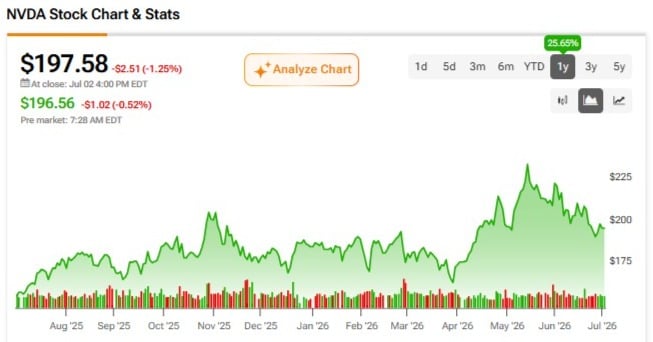
With the Fed also holding rates at 3.5%–3.75%, inflation above target, and NVDA trading near 30x trailing earnings, the stock price could drop even if the company’s profits stay perfectly healthy. We could be looking at a lower multiple on the same earnings base.
AI capex was the fuel that powered the bull run, but it’s now turned into the bull run’s primary risk. Even though the main Big Tech companies are still guiding to massive 2026 capex budgets, which support near-term NVDA demand, the bar is now also rising for downstream return on invested capital. This might not be late-stage for AI, but it may certainly be late-stage for the first wave of capex. That gives me a reason to stay neutral on semiconductor equities like NVDA for now.
The Bull Case Is Moving Up the Stack
Right now, the bull case is moving up the stack, with Nvidia’s incredible numbers. Q1 Fiscal 2027 revenue was up 85% year-over-year, and Data Center revenue was up 92%. Data Center networking surged an even more unbelievable 199%.
The future bull case is that Nvidia is becoming an AI factory systems company and moving beyond being a standard graphics processing unit (GPU) supplier. The future vector of growth opportunities lies in compute, NVLink, InfiniBand, Spectrum-X Ethernet, rack-scale systems, software, and deployment expertise collectively creating a full-stack moat for NVDA in an intensifying and complex AI market.
Rubin is probably the next catalyst, as the system should lower the cost per token and expand inference usage. Still, I’m not taking my eye off the core risks, which are exacerbated by customer concentration. Three direct customers still represented 21%, 17%, and 16% of revenue as of the last report.
Strong Earnings May Not Protect the Valuation
It’s best to separate NVDA’s earnings risk from valuation risk, because while the two are connected, it’s more nuanced than one may initially think. Nvidia can keep growing and still de-rate if investors begin treating the earnings base as more cyclical, concentrated, capex-dependent, or margin-sensitive than previously assumed.
Consider that NVDA stock merely moves from 30x earnings to 25x. This implies about a 17% downside on the same earnings base. A move to 22x implies about a 27% downside. If the multiple falls to 20x and expectations are cut by 10%, then the downside approaches 40%. I’m not that bearish, but in my opinion, investors have to keep valuation sensitivity in mind with AI semiconductor positions.
That said, Nvidia could keep compounding earnings through inference growth, networking attach, Rubin, and broader enterprise demand. Today’s valuation multiples could therefore compress more gradually and be outweighed by continuous growth. I’m not writing this horizon off, but I’m also not willing to aggressively allocate capital to the stock at this juncture. I do own a small 1% token position to monitor NVDA, but that’s all for now while I’m neutral on the future horizon.
What Does Wall Street Say about NVDA?
On Wall Street, Nvidia has a consensus Strong Buy rating, based on 36 Buys, one Hold, and zero Sells. The average NVDA price target is $309.33, which indicates about 56% 12-month upside from here. That makes the stock look like a steal, but analysts have historically often had bullish outlooks on the top stocks at market peaks. Think 2022 and 2000. I think it’s more rational to be cautious right now.

Personally, I wouldn’t size NVDA at more than 3% of net asset value (NAV), and I wouldn’t size total semiconductor exposure at more than 10% of NAV. It’s probably late-cycle, and I’d rather be safe than sorry when valuations are stretched.
If NVDA Goes Down, It’s Certainly Not Out
Even exceptional businesses can be less-than-ideal entry points, and that can be the case even if the stock has a good probability of going up in the near term. Sometimes, the downside risk outweighs the upside potential. By investing in NVDA, you are placing your capital in the hands of the hyperscalers. If they slow the growth of AI spend, then NVDA and its investors will be able to do little about it. I prefer a bit more company-level agency and a diversified direct consumer base.
At this stage of the cycle, NVDA’s downside doesn’t even have to be from earnings compressing; the valuation can contract simply due to slowing growth rates. I’m staying neutral, and I’ll monitor my small position. I may add incrementally, but NVDA is not a “fat pitch” for me at the moment.