Electric vehicle maker Tesla (TSLA) is making changes to its Full Self-Driving (FSD) software in Europe after Dutch regulators approved new speed restrictions on November 3. Under the new rules, drivers will only be able to set the system to go up to 10% above the speed limit, compared with the previous maximum of 50%. Tesla will also rename the software Tesla Assisted Driving to remind drivers that they are still responsible for operating the vehicle.
For example, on a road with a speed limit of 100 km/h, the new setting would allow drivers to set the system to drive at up to 110 km/h. Previously, they could set it as high as 150 km/h. However, drivers must still follow local speed limits, and the extra allowance is intended for situations where it may be needed for safety or traffic flow.
The Netherlands’ vehicle regulator, RDW, also said that the extra speed allowance will automatically reset to zero whenever the car starts. Other speed-related settings will initially be disabled.
Tesla will introduce these changes through wireless software updates for compatible vehicles equipped with Hardware 4 or newer.
Tesla Offers the Tech in 10 EU Countries
The latest changes come after Dutch regulators approved Tesla’s supervised driving system in April. Since then, nine other European Union countries have accepted that approval. This means Tesla can now offer the technology in 10 of the EU’s 27 member countries.
However, Germany and several other countries have not yet approved the system. An EU committee is still reviewing whether Tesla should be allowed to offer it throughout the region. Meanwhile, RDW said that its latest review found that the software changes would not negatively affect vehicle safety. As a result, Tesla will not need to repeat the original approval process.
Despite its previous Full Self-Driving name, the technology does not make Tesla vehicles fully autonomous. Drivers must continue watching the road and be ready to take control whenever necessary.
The European approval process is also important for Tesla’s business because the company earns money by selling its driving software through paid subscriptions in markets where it is available. In its third-quarter financial report, Tesla said that FSD subscription revenue increased from a year earlier and helped make up for weaker vehicle sales. The company generated $28.05 billion in total quarterly revenue, although it did not say how much of that came specifically from FSD subscriptions.
What Is the Prediction for TSLA Stock?
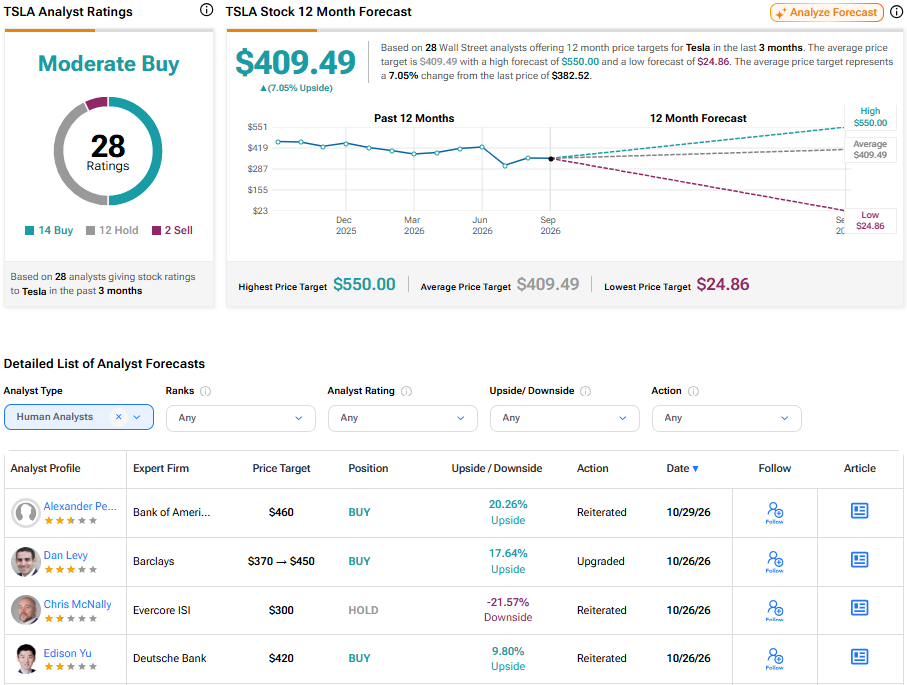
Turning to Wall Street, analysts have a Moderate Buy consensus rating on TSLA stock based on 14 Buys, 12 Holds, and two Sells assigned in the past three months, as indicated by the graphic below. Furthermore, the average TSLA price target of $409.49 per share implies 7.1% upside potential. (See TSLA Stock Forecast).