


Super Micro Computer (SMCI) just became a more diluted and complicated story, but I still think the sell-off has gone too far. The company’s recent capital raise was meant to fund its massive artificial intelligence (AI) server opportunity. Still, it was clearly ugly for shareholders, and the market was right to punish the stock in the short term.
However, I do not think this move breaks the broader investment thesis. If anything, it highlights Super Micro’s strange setup right now. AI server demand appears very strong, but capturing it requires a much stronger balance sheet. That is why I still see SMCI as a buy-the-dip opportunity, although not a clean one. The capital raise definitely makes the thesis messier, but it also reduces the risk that the high-performance server technology company misses this AI server cycle due to working capital constraints. In this article, I’ll break down this story.
A Rapid Timeline Shows Why SMCI Became So Volatile
A rapid timeline indicates why SMCI became so volatile over the past four months.

Starting in March, SMCI’s stock plummeted after the smuggling scandal. Three people linked to the company, including its co-founder, were accused of helping divert technology and servers equipped with Nvidia (NVDA) chips to China. The episode was enough to shake customer confidence.
Then, between April and May, the BlueFin report came out, claiming that Oracle (ORCL) had canceled an estimated 300 to 400 racks of Super Micro’s Nvidia GB300 NVL72 servers. If true, this would imply an estimated loss of $1.1 billion to $1.4 billion. This claim was not confirmed by Oracle, but it still contributed to the bearish trend.
Q3 Earnings and Dell’s AI Server Momentum Helped the Stock Rebound
Q3 earnings and Dell’s AI server momentum helped the stock rebound in May and early June. The key takeaway from Super Micro’s Q3 report was that gross margin rebounded to 9.9% from 6.3% in the previous quarter, even as sales fell to $10.2 billion from $12.7 billion in Q2.
In a way, this provided ammunition for the bull case that the business was alive and well. The problem appeared to be much more about working capital than demand itself.
In late May, Dell Technologies’ (DELL) earnings report reignited the trade in AI servers, and Super Micro was an automatic beneficiary of this trend. Dell reported a staggering 757% year-over-year increase in AI server revenue, with sales of $16.1 billion.
In addition, Dell raised its AI server revenue forecast for FY27 to $60 billion. This naturally boosted the entire peer group, as the market began to price in strong demand for AI servers. As a result, SMCI was trading as high as $50 per share by early June.

The Capital Raise Exposed SMCI’s Working Capital Problem
Then came a massive $7 billion capital raise that exposed SMCI’s working capital problem and quickly undermined the thesis in the short term. Super Micro’s stock took a sharp tumble, falling roughly 40% to around $30.

The company’s rationale for raising capital was quite straightforward. Super Micro receives large orders for AI servers. To fulfill them, it needs to purchase Nvidia graphics processing units (GPUs), central processing units (CPUs), memory, networking equipment, liquid cooling systems, racks, electrical components, chassis, and other components. The problem is that these components are extremely expensive. Often, the company needs to pay suppliers before receiving final payment from the customer.
As a result, Super Micro needs external funding to purchase components and fulfill customer orders. After all, the company has recently secured roughly $39 billion in orders for advanced AI servers, including Data Center Building Block Solutions, from more than 20 customers. However, SMCI itself emphasized that these orders are not firm commitments and remain subject to cancellations, delays, and contractual conditions.
The Capital Raise Sent a Mixed Message to the Market
The capital raise sent a mixed message to the market. On the one hand, demand appears to be enormous. On the other hand, Super Micro essentially admitted that it needs substantial external capital to meet that demand.
That is the working capital problem in a nutshell. In Q3 FY26, Super Micro had a negative operating cash flow of $6.6 billion and a negative free cash flow of $6.7 billion. At the end of the quarter, the company also had $11.1 billion in inventory and net debt of $7.5 billion.

Naturally, this move also led to dilution. Using the 601.4 million outstanding common shares as of April 30, 2026, as a baseline, the immediate common stock offering adds about 7.6% in new shares. The convertible preferred stock could add somewhere between 113.6 million and 136.4 million shares in the future, before accounting for the underwriters’ options.
What’s more, the $1.25 billion at-the-market (ATM) program could add even more shares depending on the sale price. At the current price of around $27.50, that would represent an additional 45.5 million shares.
The Dip Still Looks Buyable, but the Thesis Needs Calibration
That being said, the dip in Super Micro stock still looks buyable, but the thesis needs calibration. Despite all the recent market pessimism surrounding SMCI shares, I’m still inclined to buy the dip here. However, I also believe the investment thesis needs to be framed carefully.
The capital raise is undoubtedly ugly and dilutive, and a clear reminder that Super Micro’s business model is highly capital-intensive. At the same time, this capital raise significantly reduces the risk of the company losing orders due to a lack of balance sheet strength.
That matters because capturing demand at such a timely, bullish moment for AI servers seems fundamental to maintaining Super Micro’s position as a key beneficiary of this cycle. After all, in my view, this is not a market where the company can simply wait for demand to mature.
As a result, Super Micro is once again trading at roughly 13x trailing earnings. That multiple is not as depressed as the roughly 7.8x level it traded at early last year. Nevertheless, it is still a substantial discount to the industry’s 26x multiple and SMCI’s own five-year average of 20.8x. In fact, SMCI is trading at less than half of Dell’s current trailing-earnings multiple of 30.7x.
Is SMCI a Buy, According to Wall Street Analysts?
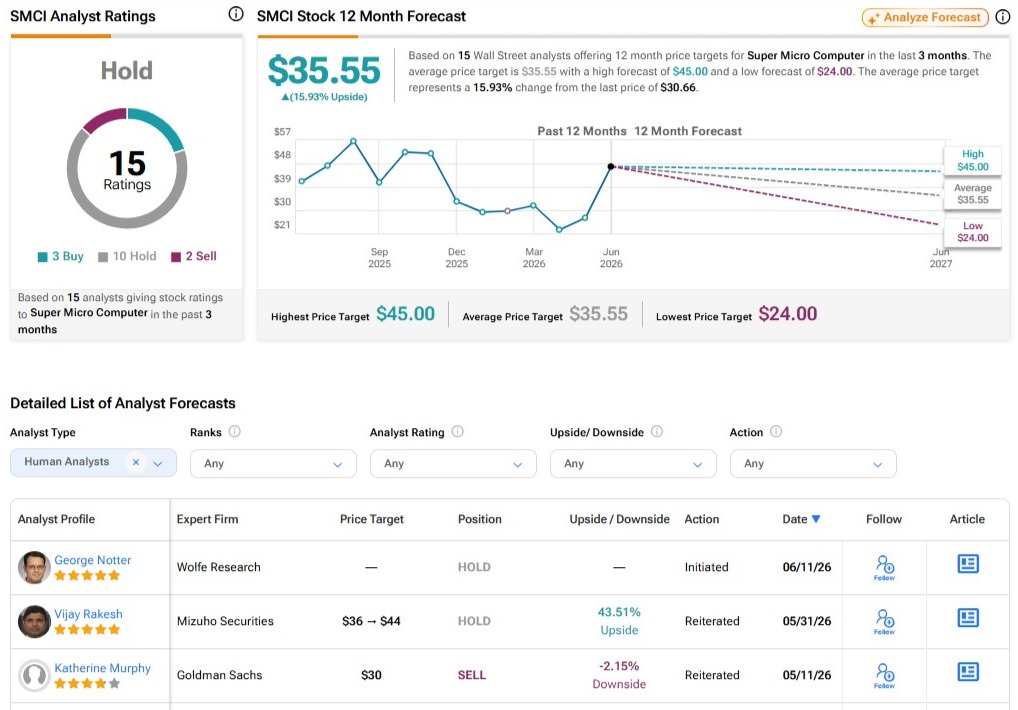
There is little enthusiasm on Wall Street for Super Micro shares, with analysts rating the stock Hold. Of the 15 ratings issued over the past three months, only three are Buys, ten are Holds, and two are Sells. The average price target is $35.55, which implies 15.93% upside from the current price.
SMCI Remains a Buy-the-Dip Story
The bottom line is that SMCI remains a buy-the-dip story, even though the setup has clearly become messier. The capital raise made the thesis harder to defend in the short term, but I do not think it breaks the broader AI server opportunity.
To me, the key point is that Super Micro now has greater balance-sheet flexibility to chase demand at a very important moment for the industry. If the company converts these large orders into real revenue, the current valuation still looks too cheap for a stock positioned this close to the AI server cycle. For that reason, I remain bullish on SMCI, but with a more cautious version of the thesis.