Chipmaking giant Taiwan Semiconductor Manufacturing Company (TSM) is considering entering the memory chip business after its biggest customer, AI chip designer Nvidia (NVDA), reportedly asked it to produce advanced 3D DRAM chips. According to The Information, the move could eventually help ease the memory shortages that have made AI hardware more expensive to build. Following the report, TSMC’s U.S.-listed shares jumped by 5.5% at the time of writing.
Nvidia’s interest makes sense because AI processors need memory chips to store information while they work. However, demand for memory has grown faster than manufacturers can produce it, which has led to shortages.
The technology that TSMC is considering could help address this problem. Traditional DRAM stores information in memory cells arranged side by side on a flat chip. In comparison, 3D DRAM stacks those cells on top of each other, which allows more memory to fit into a smaller space.
This is different from high-bandwidth memory, or HBM, which stacks entire memory chips rather than individual cells. TSMC already helps produce HBM without manufacturing most of the memory itself. In 2024, it partnered with South Korean memory maker SK hynix (SKHY) to develop the base layer used in future HBM chips.
Why TSMC’s Memory Plans Would Be a Major Change
If TSMC starts manufacturing memory itself, it would enter a new market and compete more directly with established memory producers such as U.S. chipmaker Micron Technology (MU). Micron is already spending heavily to meet demand. Earlier this year, it paid $1.8 billion for a factory site in Taiwan that it plans to use to increase advanced memory production.
For TSMC, the potential expansion comes as its existing business continues to grow. Third-quarter revenue increased by 41.2% from a year earlier to $46.72 billion. High-performance computing, which includes AI chips, accounted for 68% of its sales.
However, entering the memory business could be expensive. TSMC already expects to spend between $60 billion and $64 billion on capital projects in 2026. If it builds a new memory factory, its spending could increase further. There is also a financial risk. Memory chip prices tend to rise when demand exceeds supply. However, if manufacturers eventually produce too many chips, prices can fall before new factories have recovered their costs.
For now, TSMC is reportedly considering whether to build a new factory or purchase an existing one. The company has not announced how much it might invest or when production could begin. It also said that it does not comment on market speculation.
Is TSM Stock a Buy, Sell, or Hold?
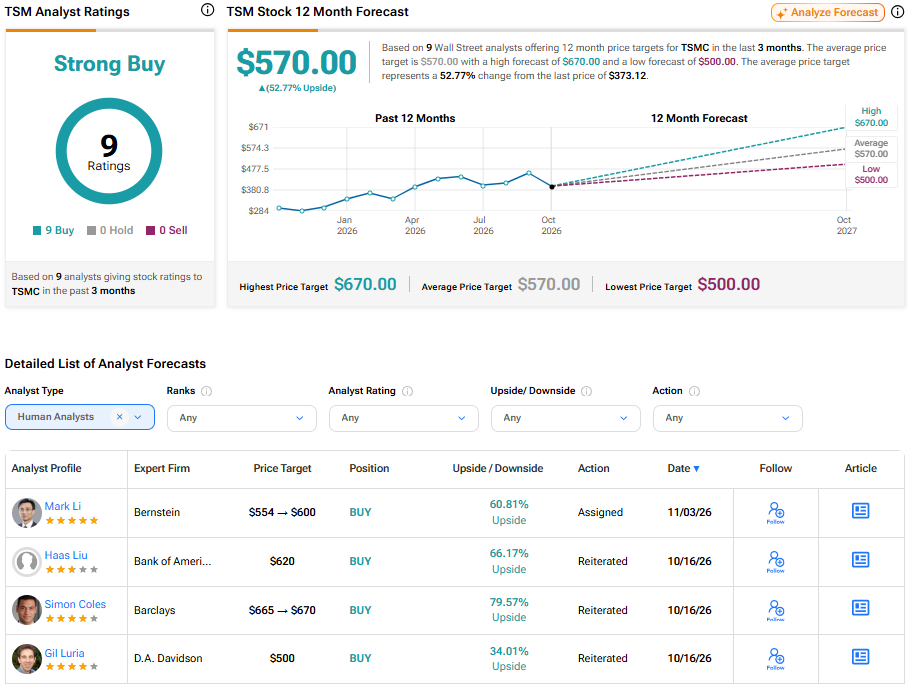
Turning to Wall Street, analysts have a Strong Buy consensus rating on TSM stock based on nine Buys assigned in the past three months, as indicated by the graphic below. Furthermore, the average TSM price target of $570 per share implies 52.8% upside potential. (See TSM Stock Forecast).