


Nvidia (NVDA) faces three major risks to its growth, but I’m not worried. Investors are questioning how long hyperscaler spending can last, whether custom chips will take market share, and whether Nvidia is indirectly financing its own customers. Each risk is real, but none of them breaks the bull case for this global leader in accelerated computing.
I’m bullish on Nvidia. Demand for its chips still outpaces supply, revenue grew 106% year-over-year in Q2 FY27, and it generates enough cash to fund large buybacks.
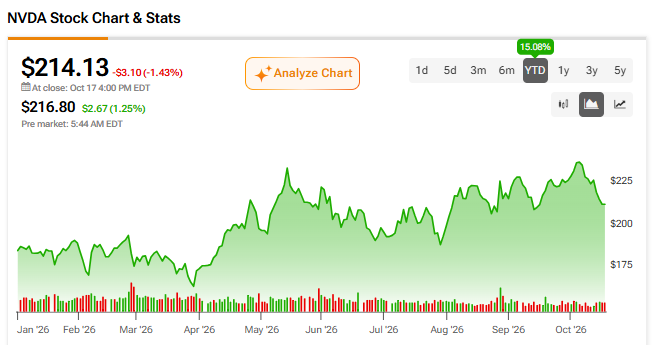
Meanwhile, earnings have grown faster than the share price. As a result, Nvidia’s valuation sits at its lowest level in three years, at 27.08x, even though the stock is up about 15% year-to-date.
Demand Is Still Running Ahead of Supply for Nvidia
Demand for Nvidia’s chips is still running ahead of supply. Management expects revenue to grow about 70% in Fiscal Year 2028 and says supply, not demand, is what limits that number. Notably, Nvidia’s outlook assumes no Data Center compute revenue from China.
Nvidia’s biggest customers keep spending, too. Management expects capex by the top five hyperscalers to reach about $1.3 trillion in 2027. Meanwhile, Amazon Web Services, Amazon’s (AMZN) cloud unit, plans to deploy two million more Nvidia graphics processing units (GPUs) over roughly the next two years.
Nvidia’s products explain much of that demand. The company says its new Vera Rubin platform can deliver up to 35x lower cost per million tokens than Grace Blackwell Ultra (GB300) on an agentic coding workload, and Nvidia has said purchase orders for Blackwell and Vera Rubin combined will reach $1 trillion through 2027. Rubin Ultra is due in 2027 and Feynman in 2028, which tells me Nvidia is planning several product cycles ahead.
The Capex Worry Is Real, but Manageable
The capex worry is real, but I see it as manageable. If hyperscalers cut spending even slightly, Nvidia would feel it strongly, and investors are increasingly asking whether building AI infrastructure pays off.
So far, most hyperscalers still earn a return on invested capital (ROIC) above 10% on a trailing twelve-month (TTM) basis, which suggests their spending is largely paying off. Amazon is the exception at 8.48%, but it also spends heavily on areas beyond artificial intelligence (AI) infrastructure.
The bigger risk sits with the AI labs. OpenAI is still not profitable, and Anthropic has only recently turned an adjusted operating profit. Yet Nvidia has invested nearly $50 billion in frontier AI labs.
Nvidia also expects demand from these labs, which it helps finance, to account for roughly a quarter of its business next year. Some investors call this circular financing.
Management’s answer is that its chips will be used by investment-grade customers or those backed by one, and that its GPUs can be redeployed to other customers if needed. I find that convincing. With demand still exceeding supply, a slowdown at one lab would free up capacity that other customers are waiting for.
Custom Chips Are a Threat, Not a Replacement
Custom chips are a threat to Nvidia, but they aren’t a replacement for its GPUs. Broadcom (AVGO) results show how fast this market is growing. Its AI semiconductor revenue grew 221% year-over-year to $16.7 billion in Q3 FY26, and custom accelerators made up 73% of it.
While these chips may not match Nvidia’s GPUs in every workload, hyperscalers can have strong incentives to deploy them for specific, predictable tasks where performance per dollar, power efficiency, and control over the hardware stack matter most.
Broadcom’s CEO even claims that custom accelerators can run workloads at about half the cost of a GPU, a claim not yet independently verified. If in-house chips gain meaningful share, they could pressure Nvidia’s long-term revenue growth and pricing power.
Nvidia’s management counters that many custom chips are built for inference at a single cloud or service, while its platform runs in every cloud and across the full AI lifecycle. The customer mix supports that view.
Non-hyperscale customers, such as neoclouds, industrial firms, and enterprises, generated $40 billion of Nvidia’s $89 billion in Q2 Data Center revenue. That alone is more than double Broadcom’s AI semiconductor revenue, and management says many of these customers have no interest in designing their own chips.
That is why I see custom silicon as a threat to Nvidia’s share at the largest cloud providers, not a replacement for its platform.
Nvidia Has Cash to Spare
Nvidia has cash to spare. Unlike the hyperscalers, it does not need heavy capital spending of its own, so most of its operating cash flow turns into free cash flow. Its TTM free cash flow reached $127 billion, one of the highest levels in the industry.
Much of that cash goes back to shareholders. Nvidia boosted its buyback program in September, bringing its remaining buyback authorization to $235 billion. In Q2 FY27 alone, it spent $20 billion on share repurchases.
I prefer buybacks to dividends, and a lower share count may also signal that management views the stock as attractively valued.
Nvidia’s Valuation Already Prices In the Worries
Nvidia’s valuation already prices in many of these worries. Its TTM GAAP price-to-earnings (P/E) ratio is 27.08x, the lowest level in the past three years, even though the business is still growing rapidly.
A comparison with Advanced Micro Devices (AMD) makes this clearer. AMD’s stock has more than doubled this year and trades at a TTM GAAP P/E of 134.96x, even though its GAAP gross margin of 54% in its latest quarter trailed Nvidia’s 75%. In my view, that gap suggests Nvidia’s share price already reflects those risks.
A low multiple can also signal peak earnings in a cyclical industry. However, management’s outlook for about 70% revenue growth in Fiscal Year 2028 suggests Nvidia’s earnings have not peaked yet.
How Does Wall Street See Nvidia?
Wall Street sees Nvidia favorably, with a Strong Buy consensus rating based on 33 Buys, zero Holds, and zero Sells assigned in the last three months. At $324.20, the average Nvidia price target implies about 51% upside potential.

UBS (UBS) analyst Timothy Arcuri, one of the top-ranked analysts on TipRanks, reiterated a Buy rating on Nvidia on October 9 with a $300 price target, implying 40% upside. He cited Taiwan’s September computer-equipment exports as a sign of healthy AI demand.
The Bottom Line
I’m bullish on Nvidia. Investors are right to watch hyperscaler capex, custom chips, and Nvidia’s exposure to AI labs. However, none of these risks outweigh a business whose demand still exceeds supply, whose cash flow funds large buybacks, and whose valuation sits at a three-year low.