Tech giant IBM’s (IBM) Nighthawk r2 quantum processor completed a computing experiment in just 19 seconds that researchers estimate could require about 110 years on the Frontier supercomputer. The test used 61 of Nighthawk r2’s 120 qubits and generated one million samples from a complex quantum circuit. Researchers described the result as an example of quantum advantage because the quantum system completed the task far faster than their estimate for a traditional supercomputer.
The experiment focused on random circuit sampling, which simply means that researchers gave a quantum computer a series of mostly random instructions. Those instructions change the qubits and connect them, thereby creating an extremely complicated quantum state.
The computer then measures that state repeatedly and produces long strings of ones and zeroes. Generating those samples is relatively easy for a quantum processor. However, recreating the same probability pattern with a normal computer becomes much harder as researchers add more qubits and more operations.
For this test, the researchers used a circuit with 36 cycles and 918 two-qubit gates. Nighthawk r2 then produced one million samples in only 19 seconds.
Researchers Estimate Frontier Would Need About 110 Years
The harder question was how long a normal supercomputer would need to reproduce the same experiment. Researchers used a simulation method called tensor network contraction. Based on that method, they estimated that reproducing the samples would require about 1.2 × 10²⁷ computer operations.
Using a conservative estimate of Frontier’s sustained performance, that translated to more than 100 years of computing time. However, the 110-year figure is not a permanent limit for traditional computers.
It depends on the specific simulation method that the researchers tested. In fact, computer scientists could eventually develop better algorithms that reduce the amount of work required.
That has happened before. After Google (GOOGL) reported a major quantum result with its Sycamore processor in 2019, researchers later developed more efficient classical methods that narrowed the original performance gap.
One notable difference this time is that Nighthawk r2 is available through IBM’s cloud platform. The researchers also used IBM’s standard cloud setup without special calibration for the experiment.
Is IBM a Buy, Sell, or Hold?
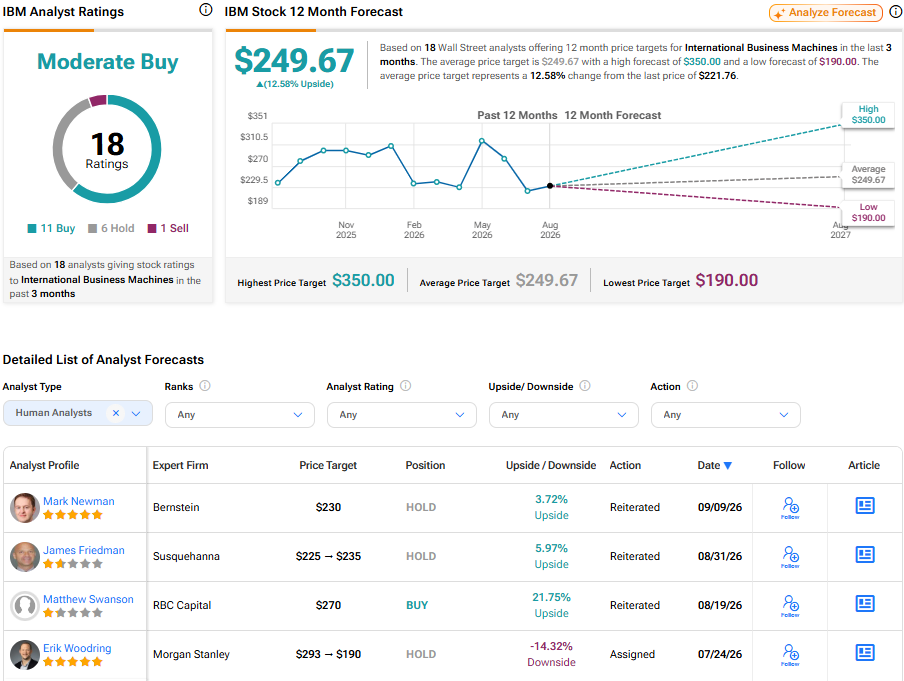
Turning to Wall Street, analysts have a Moderate Buy consensus rating on IBM stock based on 11 Buys, six Holds, and one Sell assigned in the past three months, as indicated by the graphic below. Furthermore, the average IBM price target of $249.67 per share implies 12.6% upside potential. (See IBM Stock Forecast).