


Alphabet (GOOGL) easily justifies its rising capex, with the strong growth of Google Cloud. While Wall Street remains anxious about Big Tech’s rising artificial intelligence (AI) price tag, Alphabet is delivering a clear return on capital. Google Cloud has become a primary growth engine for the business, turning expensive infrastructure investments into a high-margin, compounding revenue driver.
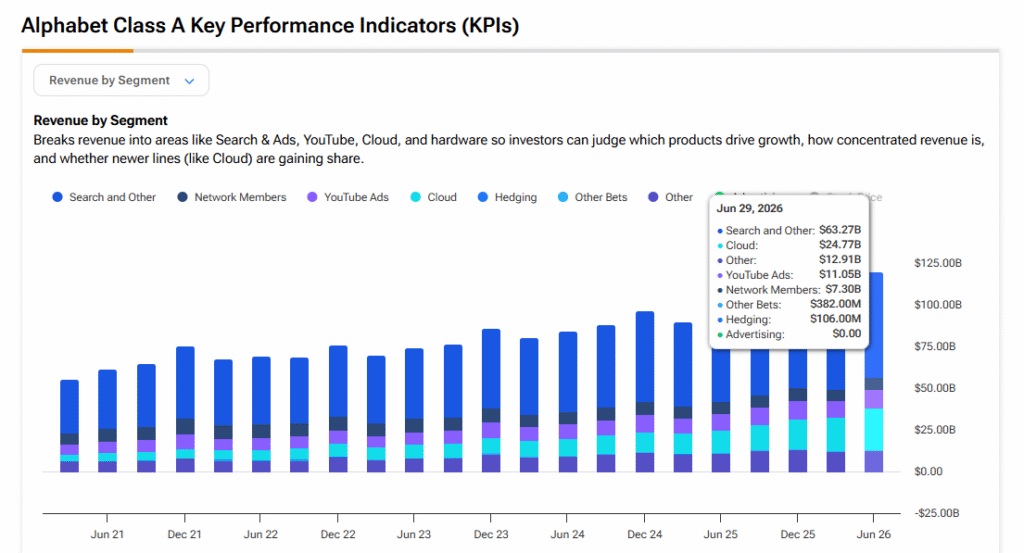
I am bullish on the stock because Cloud has become the company’s second-largest business segment after Search and has a clear path to compound growth driven by outsized capex. Tech giant Alphabet offers enterprise applications, consumer products, advertising tools, and cloud infrastructure.

Capex Expansion Is a Generational Opportunity
The risks associated with capex expansion are understandable, but this is also a generational opportunity for Alphabet. On the Q2 2026 earnings call, management updated full-year 2026 capex guidance to $195–$205 billion, up from previous estimates of $180–$190 billion.
While the capex announcement triggered a nearly 7% sell-off, the guidance was issued in response to increased capacity demand. Google Cloud’s backlog stands at $514 billion, up roughly $50 billion quarter-over-quarter. Alphabet forecasts that over 50% of the total backlog will convert to revenue within the next 24 months. This implies it plans to monetize the capacity demand to some extent each quarter, so this investment funds future revenue growth.
Given that AI token spending should only increase as token costs decline, the company is in a prime position to capitalize on this opportunity. On the recent earnings call, management mentioned nearly 500 cloud customers processed more than one trillion tokens each during the previous year, and more than 2,000 enterprises consumed over 100 billion tokens.
Q2 2026 Capex Breakdown
To break down Q2 2026 capex, management stated that 60% went to servers and hardware, such as graphics processing units (GPUs) and Google’s tensor processing units (TPUs). The remaining 40% went into data center development.
This investment could reduce Alphabet’s reliance on Nvidia’s (NVDA) chips in the long term while driving down expenses and increasing margins over time. It also enables further training for Gemini and processing search requests, which is a critical requirement for Alphabet’s revenue.
The company has been sitting on cash for years now, so it’s nice to see it being deployed, especially since mergers and acquisitions (M&A) have been off the table. As of June 30, 2026, Alphabet reported roughly $242 billion in total cash. It has an AA+ bond rating from S&P Global Ratings (SPGI). This highlights its strong financial position and shows it can support leverage if needed.
Commitments and Contractual Agreements
Along with capex, the company carries $811 billion in purchase commitments and contractual agreements, with roughly $200 billion due in the short term. This creates an issue for future cash flow because there is no way to pause them since they’re locked-in agreements.
If Alphabet were to pause capex, this could crater the stock price, but it’s at least an option. With contractual agreements for energy and raw materials for TPUs, this puts it in a bind since the AI buildout has to increase revenue for this to work. TPUs could reduce Alphabet’s reliance on Nvidia, but they also create a new risk category, as elevated inventory-related costs may change Alphabet’s revenue and margin mix.
That said, I remain bullish on Alphabet for the long term because of its balance sheet. The underlying business model is changing. Alphabet is transitioning from an asset-light, high-margin software company to an asset-heavy infrastructure company.
However, it remains one of the best capital allocators in the market. Considering it has returned a median near 22% return on invested capital (ROIC) over the past five years, I believe it has earned the benefit of the doubt.
Alphabet Is Capable of Funding Capex
Alphabet has the capability to fund capex through its current financial position. Alongside its total cash reserve, Alphabet has a 13% long-term debt-to-capital ratio compared to Amazon’s (AMZN) 21%. While Alphabet has recently tapped the debt markets to fund its AI infrastructure ramp, its balance sheet and growing net income give it ample headroom to use debt safely without stressing its capital structure.
Despite the negative $5.9 billion free cash flow (FCF) reported in Q2, cloud revenue came in at $24.8 billion, up 82% year-over-year. Google Cloud is growing faster than Azure and AWS. For comparison, Microsoft (MSFT) reported Azure cloud revenue at 43% year-over-year in its Q4 2026 earnings call, and Amazon reported 28% year-over-year AWS revenue in its Q1 2026 earnings call.
Catalysts to Watch in Q3 2026
In October 2026, there are a few catalysts I’ll be watching in the Q3 earnings report. First, I want to see how much of the $514 billion backlog is converting to revenue. A positive conversion would indicate management guidance is going as planned.

Second, I want to see how TPUs impact net income. Alphabet began recognizing TPU revenue in Q2 2026, so I want to see how this line item offsets expenses and impacts margins quarterly. Lastly, I’ll be watching for search and ad revenue. I want to see the core business remain steady, as this is critical for capex justification. In Q2, search revenue and YouTube ad revenue were reported at 17% and 13% year-over-year, respectively, so I would like to see them remain around this range.
Alphabet on Wall Street
Turning to Wall Street, Alphabet has a Strong Buy rating, based on 29 Buy ratings, five Hold ratings, and zero Sell ratings. Alphabet’s average price target of $427.81 represents 28.22% upside potential over the current price of $333.66 for the next 12 months. It also has a Perfect 10 Smart Score on TipRanks.

The Bottom Line
There are challenges ahead for Alphabet, but with the backlog steadily increasing and Google Cloud’s demand growing 82% in Q2, I believe it will overcome them and hit the average price target set on Wall Street. Given its capacity to fund this buildout, it’s hard to imagine Alphabet becoming irrelevant due to capex.