


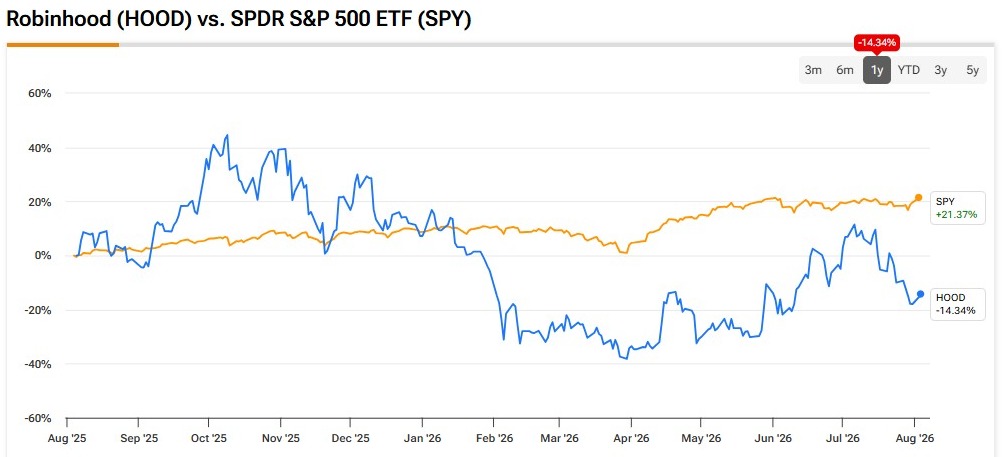
Robinhood (HOOD) posted a record second quarter, making the recent pullback look overdone, in my view. The soft post-earnings decline, following months of underperformance, suggests investors remain hung up on crypto weakness and a valuation that, admittedly, looks demanding.
Yet Robinhood is becoming a much broader financial platform while extracting more value from each customer relationship. We see record deposits and rising adoption of Gold. Meanwhile, the company is widening its product set. Thus, my HOOD forecast remains bullish despite today’s seemingly lofty multiple.
Q2 Was Better Than the Reaction
Robinhood’s Q2 was better than the initial market reaction suggested. The market had some grounds for hesitation, to be fair, as crypto transaction revenue fell 38% to $100 million. Further, $0.14 of Robinhood’s $0.62 diluted earnings per share (EPS) came from gains largely related to deconsolidation of Robinhood Ventures Fund I. Reuters put underlying adjusted EPS at $0.48 versus the $0.43 consensus. Therefore, the beat was solid, but not as spectacular as it first seemed.

Yet apart from that wrinkle, I believe the quarter was excellent. Revenue reached a record $1.31 billion, up 32% year over year and 23% sequentially. This marked a sharp acceleration from Q1’s 15% annual growth. Transaction revenue climbed 44% to $776 million. Options rose 29%, equities nearly doubled, and event-contract revenue increased more than tenfold to $156 million.
Crucially, prediction markets alone now produce substantially more revenue than crypto. So Robinhood is doing well at achieving diversification. Net interest revenue also grew 9%, while other revenue advanced 54%, driven by Gold and Trump Account service revenue.
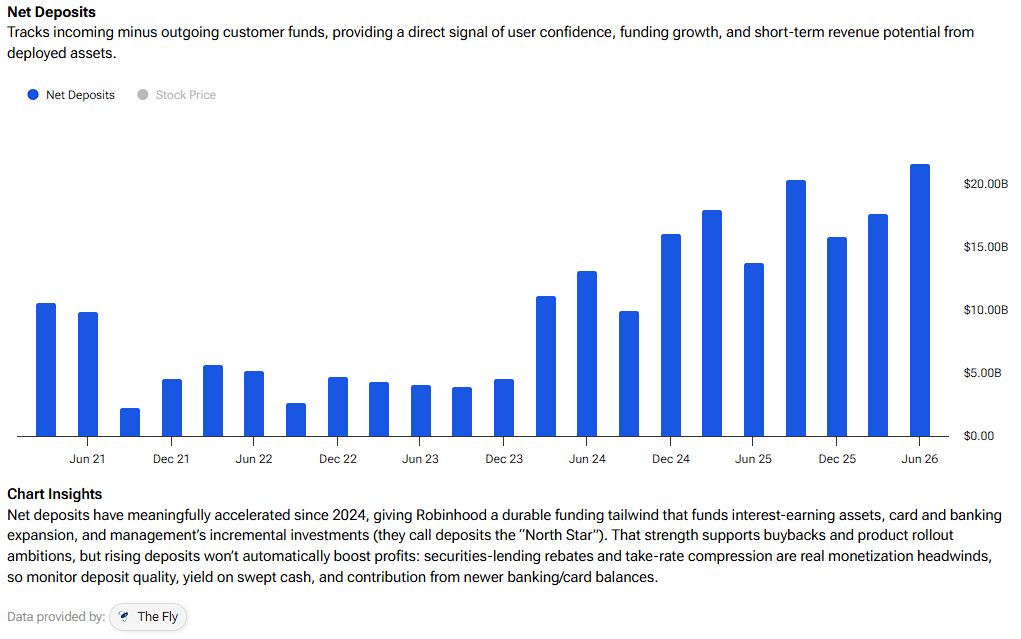
The customer economics were just as compelling. Net deposits set a record at $21.7 billion, equivalent to 28% annualized growth relative to total platform assets, helping platform assets reach $369 billion. Gold subscribers climbed 39% to 4.8 million, and average revenue per user increased 24% to $187. This is quite impressive considering funded customers grew only 7%.
So what we are seeing is that Robinhood is deepening existing relationships. It’s not merely buying new accounts. With 13 business lines now above $100 million in annualized revenue, adjusted EBITDA increased 35% to $741 million. Adjusted EBITDA margin reached 57%, which was also outstanding.

Q3 Should Extend the Growth Run
I believe Q3 should extend the growth run. Management highlighted that July’s daily equity, options, and event-contract volumes were tracking around Q2’s record levels, while net deposits were heading toward $4 billion before counting Trump Accounts. Better still, management lowered and tightened this year’s adjusted operating-expense-plus-stock-compensation outlook to $2.68 billion–$2.78 billion.
This expense guidance reduction holds even after absorbing costs from the Rothera exchange joint venture and WonderFi acquisition. The updated full-year forecast represents unusually constructive guidance. Robinhood continues to fund growth initiatives while internal efficiency gains offset a portion of those investments.
In the meantime, the product pipeline gives those active customers more reasons to stay. Robinhood’s Gold Card has passed 1 million users and $17 billion of annualized purchase volume. Banking has more than $3 billion of deposits, and Strategies has nearly $2 billion under management. International funded customers exceeded 1 million, while stock tokens are available through Robinhood Wallet in more than 120 countries.
These products are key because each moves Robinhood closer to being the customer’s primary financial account. This will help to counter the views of some investors who still treat Robinhood as the app people opened during a meme-stock rally.
Also, that shift should expand margins. Robinhood must build the technology, compliance, and support infrastructure upfront. However, an additional trade or Gold subscription costs relatively little to serve. More assets can generate higher transaction revenue, margin interest, securities-lending income, and subscription revenue without Robinhood having to reacquire the same customer.
Q2 already demonstrated the mechanism, as revenue rose 32% while adjusted operating expenses and stock compensation grew 23%, allowing EBITDA to rise faster than sales. As cross-selling improves, that operating leverage should become more visible.
The Multiple Can Compress Quickly
Robinhood appears expensive today, but I believe the multiple can compress quickly. The business does not need further momentum for this to take place. At about $90 per share, HOOD trades roughly 41% below its 52-week high. Based on the consensus estimate of $2.06 in 2026 EPS, the stock still changes hands at about 42x forward earnings. That is a demanding valuation for any brokerage platform, with the sector median P/E at around 12x.
It also leaves the shares vulnerable to weaker crypto trading, restrictions on prediction markets, or signs that deposit growth is beginning to cool.
Still, Robinhood is no longer just another online broker, so valuing it as one does not make much sense. A revenue increase of more than 25% next year may sound ambitious, but Robinhood does not need everything to go perfectly to get there. Event contracts are spreading beyond sports, and the platform is still winning business in equities and options. Deposits help on several fronts, too, as they bring in more Gold members, create demand for margin loans, and give Robinhood more assets to move into advisory accounts. Crypto and international expansion are not essential to the argument, but either could lift growth beyond that level.
Because much of the cost base is fixed, 25%-plus revenue growth can translate into materially faster EPS growth, rapidly shrinking today’s P/E. Of course, the valuation demands execution. However, Q2 offered unusually strong evidence that management is delivering it. In fact, Robinhood has consistently beaten expectations lately despite the market downplaying its potential.
Is HOOD a Buy, Sell, or Hold?
Despite its lagging share price, Robinhood stock continues to have a Strong Buy consensus rating on Wall Street. This is based on 15 Buy and three Hold ratings. Notably, no analyst rates the stock a Sell. Further, HOOD’s average price target of $121.93 implies about 35% upside potential over the next 12 months.

Conclusion
As a broker, Robinhood is still exposed to market swings and regulatory risk. This is why I would not describe it as a low-risk compounder. However, the business now has more ways to grow. Customers continue to move more money onto the platform, and expenses are rising far more slowly than revenue. With the shares well below their previous high, I think the potential return now outweighs the risks.